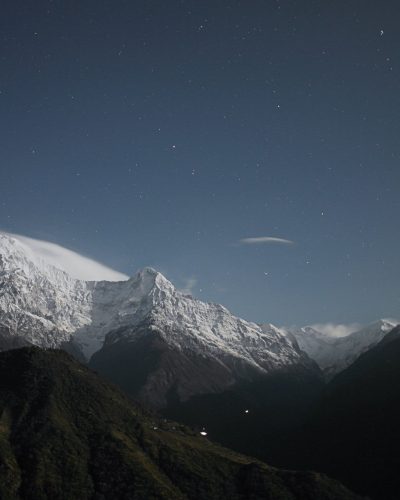
More than a week ago, when the PKK announced that a number of its members would symbolically destroy their weapons in a ceremony open to the press, I did what every sensible journalist familiar with the Kurdish issue would do: I applied for accreditation to witness this historic moment. Just two days earlier, I had been in the village of Conag in Bingöl, collecting mulberries with my family and making molasses. As I awaited confirmation for the ceremony, my accreditation was granted. Gazing into the deep blue sky meeting the lush green of the Peri Valley—a place forcibly evacuated under state pressure in the early 1990s and now slowly being repopulated—I had one question in mind: Would my people, the Kurdish people to whom I belong and whose culture I cherish with pride, finally be able to live freely and in peace?
The PKK, formed forty-seven years ago by a group of predominantly Kurdish and Turkish revolutionary youth, was born out of centuries-long denial and forced assimilation of Kurds on their ancestral lands. It defined itself as a freedom and independence movement, committed to securing a free, equal, and dignified life for Kurds. The movement, which regards the right to life—not only for humans but for all beings—as its primary principle, resorted to armed struggle only after all attempts at negotiation failed. Today, the Kurdistan Freedom Movement, officially named the Kurdistan Workers’ Party, organised a ceremony destined to go down in world history—not to glorify war, but to leave it behind.
Fifteen women and fifteen men, including four senior figures such as KCK co-chair Bese Hozat and Behzat Çarçel, led this ceremony. Writers, human rights activists, and Peace Mothers—women who have lost their children to war and devoted their lives to peace—were among the guests.
To remember what led to this day: on 27 February 2025, PKK founder Abdullah Öcalan called on the movement to dissolve itself. In the days that followed, the movement held its congress and announced its formal disbandment.
This move came after decades of conflict throughout Turkey and the Middle East. On 22 October 2024, a new process—possibly the most promising step towards permanent peace—began. MHP leader Devlet Bahçeli publicly called on Abdullah Öcalan to take action. From there, the so-called new process was launched, leading to backchannel talks and eventually a communication channel between the Turkish state and Kurdish political actors. Efforts by the Imralı Delegation of the DEM Party, various public meetings, party-level dialogues, and the cumulative impact of more than four decades of political struggle bore fruit.
To capture this in just one example: our press bus journey.
On Thursday, 10 July, I joined over 130 people travelling from Diyarbakır (Amed)—where I had lived 10 years ago just before moving to London—to Sulaymaniyah. It was scorching—over 40 degrees Celsius—and the mood was a mixture of anxiety and excitement. Journalists, activists, politicians, DEM Party co-chairs, MPs, Peace Mothers, lawyers, and civil society representatives were on board. We were on our way to witness something unthinkable a decade ago: PKK members publicly laying down their arms.
The night before the journey, I was sitting at a table with the DEM Party’s Istanbul press representative, who was telling me about moving to Istanbul after their village in Tatvan was burned down in 1993. He remembered all the details, even though he was only four years old back then. A random meeting between two Kurds would never be different from the chat we had. As a result, everything that was about to happen concerned all of us deeply.
For the majority of Kurds, the PKK is not just a political movement—it is woven into daily life. Weapons, for many, have become not only a symbol of revolution but also of survival and resistance. This is what made the ceremony so historic: it marked the end of an era in which tens of thousands of people on both sides lost their lives.
We left Diyarbakır with immense excitement and uncertainty about what awaited us. Four large buses were organised by the DEM Party; the press travelled in the front bus, labelled No:1, a name reminiscent of the prisons where many of our loved ones remain incarcerated for fighting for freedom of speech, the Kurdish issue, and human rights.
Our first stop was in Cizre for a break. Memories overwhelmed me, taking me back ten years, when I reported on Cemile Çağırga, a ten-year-old girl killed by a sniper in front of her house. Her mother kept her body in a freezer for three days. It was devastating news for Kurds.
In Cizre, we had dinner and were hosted by the warmest people. DEM Party co-chairs Tuncel Bakırhan and Tülay Hatimoğulları, along with other politicians, joined us. Despite the city’s dark history during 2015 and 2016, the atmosphere was hopeful.
While having dinner, I sat next to Öztürk Türkdoğan, former head of İHD (Human Rights Association) and now deputy co-chair of the DEM Party’s Legal and Human Rights Commission. Another journalist, who would later be stopped at the Habur border due to a previous trial, Bilal Güldem, asked him: “If you’re Kurdish, why do you have a Turkish name?” Türkdoğan’s reply—“Our names are a product of the denial and assimilation policies that began with the 1936 Surname Law”—was a sharp reminder of the unrelenting pain tied to Kurdish identity.
Almost everyone around me had a story like this. The Istanbul press officer for the DEM Party told me how his village in Tatvan was burned down overnight when he was just three years old. The next day, he and his family travelled to Istanbul in the back of a lorry—a 24-hour journey into exile.
Crossing the Habur border was especially tense. We all remembered the 2013–2015 peace process, which abruptly ended when the Turkish government rejected the Dolmabahçe Agreement. Also in our minds was the fact that just 16 years ago, 34 PKK members walked through this border into Turkey, only to be arrested despite government promises. The Habur border symbolised Kurds’ growing distrust in the Turkish state’s sincerity in bringing peace. During that period, thousands of guerrillas had withdrawn from Turkey to Qandil.
Among those heading to the ceremony was Ali Fuat Önder, brother of the late DEM MP Sırrı Süreyya Önder—a major figure in Kurdish politics who died two months ago. Alongside civil society activists and veteran politicians, the journey lasted nearly twelve hours and ended just before midnight in Hewlêr (Erbil). From the generous hospitality in Cizre to the grand hotel in Hewlêr, every detail was meticulously planned.
In Duhok, a large welcoming ceremony was held by the Iraqi Kurdish Government, where DEM and DBP party co-chairs gave a press briefing.
We arrived in Hewlêr at midnight. Though exhausted by the heat and the long journey, we were all excited for the next day, as many other journalists from around the world came to Sulaymaniyah to witness a historic moment.
After a few hours of restless sleep, we set out before 7 a.m. The road felt endless, weighed down by anticipation and a thousand unanswered questions. Who would the guerrillas be?
We were escorted by around twenty luxury vehicles to the ceremony site. It was clearly a massive operation—not only organised by the DEM Party, but largely supported by the Iraqi Kurdish Government.
What would the ceremony look like? The road led us to Dukan, then finally to the Casene Cave where the ceremony would unfold.
The area was surrounded by security personnel in varying uniforms. A large crowd stood staring at the stone steps leading to the historic cave, waiting over an hour for the guerrillas to appear.
Led by Bese Hozat, the group finally arrived. Greeted by zılgıts and applause—despite announcements urging silence—the guerrillas were embraced emotionally by Peace Mothers, activists, and politicians. Chants of “Biji Serok Apo” [Long Live Leader Öcalan] echoed.
In the front rows sat DEM Party politicians. Opposite them were representatives of the Iraqi Kurdish Government and mainstream Turkish media. Although we, the press, had been told not to bring devices, some pro-government journalists managed to keep their phones.
As hundreds of journalists watched, unable to record, some remarked how this would live on even more vividly in memory because it wasn’t filtered through a screen.
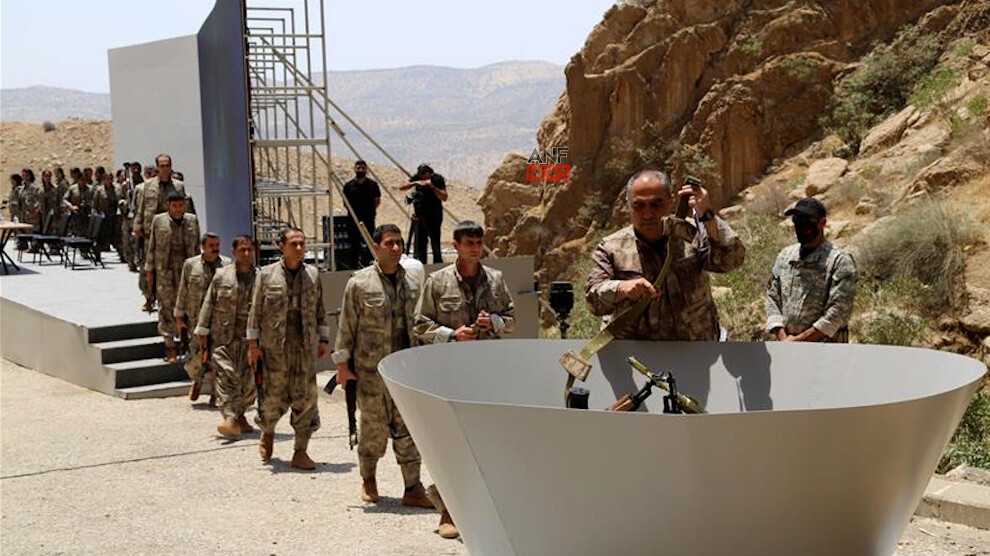
A statement was read in both Turkish and Kurdish. Then, one by one, the guerrillas threw their weapons and utility belts into a large, purpose-built container. After pouring an accelerant, Bese Hozat and Behzat Çarçel set the pile alight. It was a moment that stunned all present—a symbolic act marking a new chapter in Kurdish history.
We struggled to contain our emotions. Deep breaths, clenched muscles—tears were the only way to carry what even mountains couldn’t bear.
Then, from the top steps of the cave, the female guerrillas emerged one by one, followed by Bese and then the men. The group was greeted with applause and shouts that moved nearly everyone present.
I couldn’t take my eyes off the female guerrillas for several minutes. Then Bese Hozat began to speak with calm, resilience, and dignity. She welcomed us warmly to these mountains that had been their home for decades. I tried to suppress my excitement, giving silent commands to every part of my body to stay composed and absorb every moment of the ceremony—one I knew I’d never forget.
At the special request of a journalist friend from London, I approached a woman who I was sure was a guerrilla. Thin but strong-looking, with a black hat, glasses, and tanned skin, I quietly asked my colleague standing beside her who she was. When I learned who she was, I shook her hand and said I had a message. I told her I wanted to hug her on behalf of my friend—and she embraced me with a warm smile. I handed her an Amedspor pen—one of the only two items I was allowed to bring. She smiled and said “wow”, and for the rest of the day, I noticed the pen never left her hand. That tiny gesture felt like it travelled across the entire ceremony grounds.
While some of us regretted not taking a stone from the mountain, we were deeply moved by the stones Ali Önder took with him to place on his brother’s grave.
A text was read, a ceremony was held. Thirty guerrilla members, aged between 21 and 60, burned their weapons. The Kurdish freedom movement had taken another step—as it has done for forty years—so Kurds can build an honourable and equal life.
No one knows how many more lives, bullets, or ceremonies will be needed for peace.
On the way back, the bus was unbearably hot—the air conditioning was either broken or switched off. Journalists grumbled, tired but amused. Then someone asked, “Who wants some baklava?”—a gift from the politicians, left untouched.
Müslüm Yücel from Urfa said, “In the ’90s, I crossed this river without a passport. Everyone was against us. Now, we came through in a convoy with heavy security. It feels different—better.”
Yusuf Tunçer, Aydınlık’s diplomacy correspondent, called the trip both a duty and a personal journey. The ceremony was simple—not a celebration, but a humble recognition of a long struggle. A message that peace demands humility, not spectacle.
Dicle Müftüoğlu, the only female journalist in our group who spoke openly, was born the year the PKK began its armed struggle. “Witnessing this felt like a privilege,” she said, tears in her eyes. “My whole life has been about this fight—the pain, the losses, the hope. Seeing the guerrillas lay down their weapons was powerful. It wasn’t just a ceremony—it was a reckoning, maybe the start of peace.”
This ceremony was far more than a mere news event. It was a defining chapter in my life as a journalist—a testament to decades of pain, courage, and an unyielding pursuit of dignity. While the road ahead remains uncertain, witnessing the Kurdish freedom movement take this bold step towards peace has left an indelible mark on me. No story I have told before or will tell again will carry the same profound meaning.
Source: ANF News