
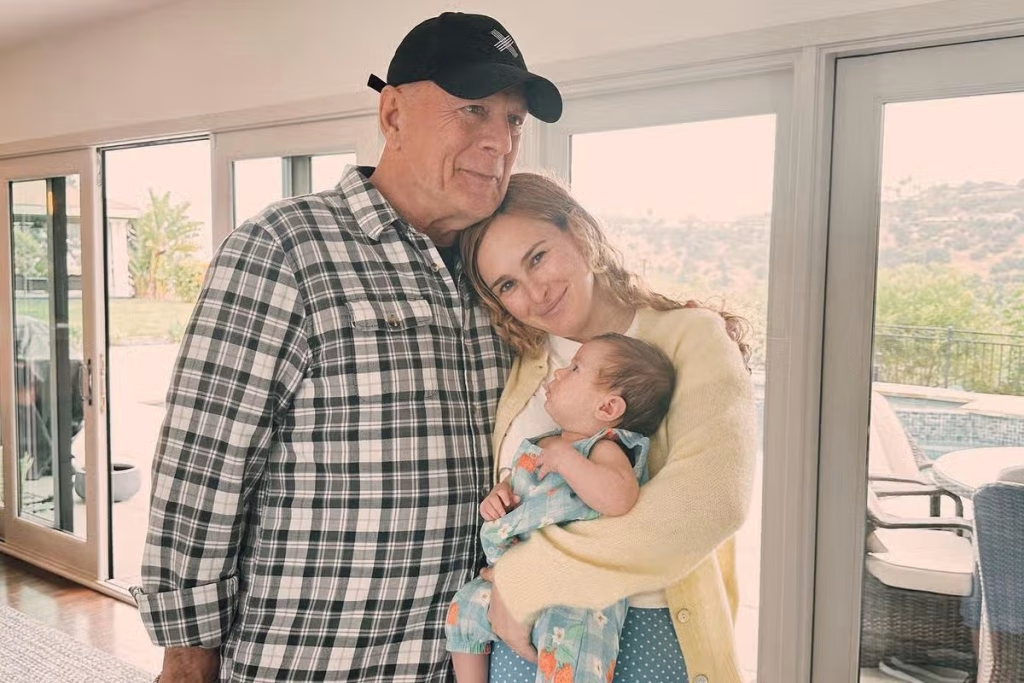
For Rumer Willis, taking control of her health has become deeply personal.
The 38-year-old actress and eldest daughter of Bruce Willis and Demi Moore recently opened up about undergoing genetic testing to better understand her potential risk of developing Alzheimer’s disease, a decision that comes as her family continues to navigate Bruce Willis’ frontotemporal dementia diagnosis.
In an August 24 Instagram post, Rumer revealed her partnership with Function, a health-focused membership platform, through which she underwent an APOE gene test designed to assess genetic risk associated with Alzheimer’s disease. She said the results placed her in what was described as an “average” risk category.
But the test was about more than a number on a report. For Rumer, it was part of a broader effort to be proactive about her health while confronting the emotional reality of watching her father live with a progressive neurological disease.
“I miss my dad,” she wrote, reflecting on Bruce and the changes she has witnessed in him. “I miss a different version of who he was.”
She acknowledged that there are days when the situation remains particularly difficult, while also describing the importance of accepting the reality of where her father is now.
“There are some days that are just so hard,” Rumer said. “I try to prioritize being present with where he is at now.”
That tension — grieving aspects of the person someone once was while remaining present with the person they are today — has become a defining part of the Willis family’s public experience with dementia.
Rumer Willis confronts a deeply personal health question
Rumer’s decision to undergo genetic testing is particularly significant because of her family’s experience with dementia.
Bruce Willis’ family first announced in March 2022 that the actor would step away from acting after he had been diagnosed with aphasia, a condition that can affect a person’s ability to communicate. In February 2023, the family announced that his condition had progressed and that he had received a more specific diagnosis of frontotemporal dementia, or FTD.
The Associated Press reported at the time that FTD involves degeneration in the brain’s frontal and temporal regions and can affect behavior, language and movement. The family said communication difficulties were only one part of what Bruce was experiencing.

FTD is distinct from Alzheimer’s disease, although both are forms of dementia. The fact that Bruce has FTD does not mean that Rumer has inherited Alzheimer’s disease, nor does her genetic test indicate that she will develop the condition.
That distinction is important when considering Rumer’s disclosure.
Her APOE test was intended to provide information about one aspect of Alzheimer’s risk rather than a definitive prediction of her future health. Rumer said that learning her risk was “average” gave her useful information, even though she found the process emotionally daunting.
“I think when you have information, it’s power,” she told PEOPLE.
In an interview with PEOPLE, Rumer also described the difficulty of receiving genetic information when there is already a history of serious illness in the family.
“It’s terrifying to get answers sometimes,” she said, adding that dementia is not the only health concern she has encountered among relatives. She also referenced family members who have had breast cancer and other medical conditions.
The comments underline why genetic testing can carry an emotional dimension that goes beyond the science. A test may offer information, but receiving that information can also force someone to confront possibilities they would otherwise be able to leave in the abstract.
Living with the changing reality of Bruce Willis
Rumer’s comments about missing her father come against years of increasingly public discussion about Bruce Willis’ condition.
The actor, whose career includes landmark films such as Die Hard and The Sixth Sense, retired from acting after his aphasia diagnosis. His family later became increasingly vocal about FTD, using their public platform to raise awareness of a condition that remains less familiar to many people than Alzheimer’s disease.

When Bruce’s FTD diagnosis was announced in 2023, his family described the clarity of the diagnosis as painful but also a relief after an earlier period of uncertainty. The family’s statement emphasized that FTD can affect language and other areas of functioning and called for greater awareness and research.
The disclosure also brought together members of Bruce’s blended family. His wife, Emma Heming Willis, has spoken extensively about caregiving and has worked to raise awareness about the challenges faced by families living with dementia. The Associated Press reported in 2024 that Heming Willis was preparing a book based on her experience caring for Bruce, incorporating personal experiences, expert interviews and practical advice for other caregivers.
Rumer’s latest comments add another perspective: that of an adult daughter trying to process a parent’s illness while simultaneously considering what that experience might mean for her own future.
Her description of learning to hold two emotions at once is particularly revealing.
“The truth is, to be strong is learning to deal with two both at the same time,” she said.
Rather than presenting strength as an absence of grief, Rumer described it as the ability to acknowledge the sadness while still remaining engaged with the present.
Why the genetic test matters to Rumer
According to PEOPLE’s report, Rumer was drawn to Function’s testing because she wanted a clearer picture of her health and possible predispositions.
Her interest in preventive health also predates her father’s dementia diagnosis. In her interview with PEOPLE, she described taking an increasingly proactive approach to her overall wellbeing, including areas such as brain health, gut health and reproductive health.
She framed the genetic information as something that could help guide conversations with healthcare professionals rather than as a prediction of what must happen in the future.
That distinction is especially relevant when discussing APOE.

APOE is a gene involved in lipid transport and metabolism, and certain variants are associated with differences in the risk of developing late-onset Alzheimer’s disease. Having a particular variant does not, by itself, establish that a person will develop Alzheimer’s, while not having a higher-risk variant does not guarantee that someone will never develop it.
Rumer’s description of her result as “average” therefore represents information about risk, not a diagnosis or a guarantee about her future.
Her decision to share the experience publicly also reflects the increasingly common conversation around genetic information and preventive health. For someone whose family has been confronting dementia in such a visible way, the desire to replace uncertainty with information is understandable.
At the same time, Rumer acknowledged that knowing more can itself be frightening.
The two ideas — information as empowerment and information as a source of anxiety — run throughout her comments.
Motherhood has added another dimension
Rumer is also approaching these questions as a mother.
She shares her three-year-old daughter, Louetta Isley, with former partner Derek Richard Thomas. The young girl has become a visible part of Rumer’s life, including in family photographs with Bruce.
Louetta’s name carries a connection to her grandfather. According to the original report by HELLO! and reporter Beatriz Colon, her name was inspired by two of Bruce Willis’ favorite musicians, Louis Armstrong and the Isley Brothers.
The family connection makes Rumer’s reflections about health particularly poignant. Her concern is not simply about her own future; her comments to PEOPLE also connect her efforts to staying healthy and present for her daughter for as long as possible.
That perspective helps explain why genetic information has become meaningful to her. Rather than waiting for a health crisis to force action, she says she wants to understand what she can about her health now.
In her PEOPLE interview, Rumer discussed practical choices she has incorporated into her approach to wellbeing, including taking supplements, cooking at home and avoiding perfumes. These are personal choices she has described as part of a broader philosophy of being proactive about health, rather than medical recommendations for preventing dementia.
A family that has increasingly spoken publicly about dementia
The Willis family has gradually transformed an intensely private family experience into a public conversation about dementia.
Bruce and Demi Moore were married from 1987 until 2000 and have remained close. Their daughters are Rumer, Scout and Tallulah. Bruce later married Emma Heming Willis in 2009, and they have two daughters, Mabel and Evelyn.
The family has continued to share occasional glimpses of Bruce’s life, including photographs with his children and granddaughter. In March 2026, Demi Moore shared a photograph featuring Bruce with Louetta, Rumer’s daughter, according to the original HELLO! report.
For the family, these moments provide a way of showing that Bruce remains part of their lives even as his illness has changed the nature of their relationship with him.
Rumer’s words about missing “a different version” of her father capture that complicated reality more directly than a photograph can.
There can be love and connection in the present while still being grief for what has been lost.
That is particularly relevant in frontotemporal dementia, where changes to communication, behavior and other functions can alter the ways family members interact with someone long before a person’s physical presence disappears. The Associated Press has noted that FTD can affect language, behavior and movement, with symptoms varying from person to person.
Rumer’s message is ultimately about uncertainty
Rumer’s disclosure does not establish that she is developing Alzheimer’s disease, nor does Bruce’s FTD diagnosis mean that his daughter will necessarily develop dementia.
Instead, her decision illustrates how living alongside a serious neurological illness can change the way a family thinks about health.
For Rumer, genetic testing provided one piece of information in a much larger picture. Her result was described as average, but she still came away with a renewed determination to pay attention to her health and make choices she believes may support her long-term wellbeing.
The emotional side of that process remains just as important.
She is a daughter missing aspects of the father she remembers, while trying to stay present with the father she has today. She is also a mother thinking about the years ahead with her own young daughter.
Those realities exist simultaneously.
And that may be the most revealing part of Rumer’s decision to speak publicly: her approach is not about claiming certainty where none exists. It is about confronting uncertainty with information, while acknowledging that the information itself can be difficult to absorb.
For a family that has spent the past several years living with the consequences of Bruce Willis’ frontotemporal dementia, the search for knowledge has become part of how they cope, advocate and plan for the future.
Rumer’s latest step is a deeply personal extension of that journey.
Source attribution: This article is based on reporting by Beatriz Colon for HELLO!, including Rumer Willis’ Instagram comments and family background, with additional interview details reported exclusively by PEOPLE. Background on Bruce Willis’ frontotemporal dementia is also supported by Associated Press reporting.
The post Rumer Willis Opens Up About Bruce Willis as She Takes a Closer Look at Her Alzheimer’s Risk appeared first on Owink.
Source: Owink