
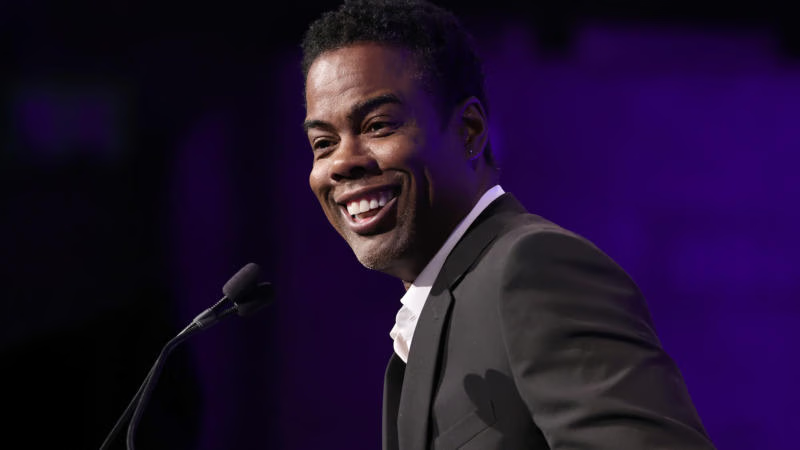
Chris Rock has built a career around turning uncomfortable subjects into comedy, but his latest comments about money have given fans an unexpectedly candid glimpse into the financial consequences of his divorce.
The comedian, actor and filmmaker recently joked that his bank account has never quite recovered from his split from Malaak Compton-Rock, his wife of 19 years. Speaking with Variety about his career and some of his best-known movie roles, Rock connected his financial situation directly to his desire to return to one of his biggest franchises: Madagascar.
“I got divorced,” Rock said during the interview. “I don’t have Madagascar money anymore.”
The remark was delivered in the characteristically dry style that has become a hallmark of Rock’s comedy, but it immediately drew attention because of the financial history behind the joke. According to HELLO!, in a report by Faye James, Compton-Rock received an estimated $40 million as part of the couple’s 2016 divorce settlement.
Rock’s comments therefore landed as more than a passing reference to an old marriage. They also revived interest in how one of Hollywood’s most successful comedians rebuilt his finances and career after a divorce that followed nearly two decades of marriage.
Chris Rock wants another Madagascar
The immediate subject of Rock’s Variety interview was not his divorce but his extensive film career, including the animated Madagascar franchise.
Rock voiced Marty the zebra in the series, appearing alongside Ben Stiller, Jada Pinkett Smith and David Schwimmer. The first Madagascar film arrived in 2005 and became a major global success, eventually leading to two direct sequels.

Fourteen years after the release of Madagascar 3: Europe’s Most Wanted, Rock made it clear that he would welcome another installment.
“It’s probably the biggest movie I’ve ever been in,” he said, according to the interview cited by HELLO! “We did three of them; I pray to god we do one more.”
His argument was partly based on Hollywood’s long-running appetite for revivals, sequels and reboots.
“In a world where they’re rebooting everything, let’s do Madagascar,” Rock said.
He then brought the conversation back to his finances, joking that the three existing films were not enough.
“We only did three. There’s five Ice Ages…I need another Madagascar. It’s time.”
The comments prompted an immediate reaction from viewers on social media, with some jokingly interpreting Rock’s remarks as a reference to the money involved in his divorce. Others responded more broadly to the idea of a celebrity whose enormous earning power could still be significantly affected by a major divorce settlement.
Rock’s comments, however, were presented as a joke rather than a detailed accounting of his current finances. There is no indication in the interview that he was claiming to be financially struggling in an ordinary sense.
The enormous business behind Madagascar
Rock’s reference to Madagascar carries particular weight because the franchise became one of the most commercially successful animated properties associated with its generation.
According to the figures cited by HELLO!, the three Madagascar movies have generated more than $2.2 billion worldwide.
Rock’s participation in the franchise was just one part of a much larger entertainment career. His work has stretched across stand-up comedy, television, film and voice acting, giving him multiple sources of income over several decades.

He was a cast member and writer on Saturday Night Live, later created and starred in Everybody Hates Chris, and appeared in projects including Fargo. His stand-up career, meanwhile, became one of the central pillars of his financial success.
That combination is important when considering his comment about no longer having “Madagascar money.” Rock was not dependent on a single movie franchise for his livelihood. Instead, Madagascar represents one particularly lucrative and recognizable chapter in a career that has generated income across several forms of entertainment.
The Netflix deal that changed the scale of his earnings
Rock’s post-divorce financial story also includes one of the most significant comedy deals of the 2010s.
Forbes reported that Rock earned $57 million between 2016 and 2017, with much of that income coming from a $40 million Netflix deal.
That agreement resulted in two major comedy specials: Chris Rock: Tamborine and Chris Rock: Selective Outrage. The deal demonstrated the growing value of established stand-up comedians to streaming services at a time when major platforms were investing heavily in exclusive comedy programming.

For Rock, the deal also came during a period when his personal life had become an increasingly visible subject of his material.
His comedy tour following the divorce was called the Total Blackout Tour. Rock famously referred to it as the “alimony tour,” turning the financial implications of his separation into part of his stage persona.
That approach has long been central to Rock’s work. Rather than keeping difficult experiences completely separate from his comedy, he has frequently transformed them into material, allowing audiences to encounter personal subjects through satire and exaggeration.
A divorce that followed 19 years of marriage
Rock and Compton-Rock married in 1996 and separated in 2014 after 19 years together. Their divorce process continued for roughly two years before the settlement was finalized in 2016.
At the time of their separation, Compton-Rock issued a statement acknowledging the end of their marriage while emphasizing the importance of their family.
“After much contemplation and 19 years of marriage, Chris and I have decided to go our separate ways,” she said, according to the statement cited by HELLO!.
She also emphasized her work serving vulnerable communities and asked for privacy during what she described as a significant transition for the family.

Rock and Compton-Rock have two daughters, Lola and Zahra. In her statement, Compton-Rock specifically said that the children’s well-being remained her priority and requested that the family’s privacy be respected.
The eventual settlement became one of the more financially significant celebrity divorces associated with a major comedian of that era. HELLO! reports that Compton-Rock was awarded an estimated $40 million in the 2016 settlement.
The figure has since become a recurring part of public discussion surrounding Rock’s finances, particularly because of the comedian’s willingness to joke about the financial realities of divorce in his stand-up.
Rock turned the experience into comedy
Divorce is rarely an easy subject for public figures, particularly when the financial details become part of the public conversation. Rock chose a different route, making the experience a prominent component of his comedy.
In his Tamborine special, he joked about the expense and emotional absurdity of divorce, including the cost of hiring lawyers.
“You don’t want to get divorced, I tell you right now,” he said in the special. “If you’ve got somebody you love, hold tight.”
He then compared paying a divorce lawyer to hiring someone to carry out an attack against you.
The joke reflected the broader tone of the material Rock developed after his marriage ended. Rather than presenting himself simply as a victim of financial loss, he used the experience as material for examining relationships, money, responsibility and the aftermath of a long marriage.
That distinction matters when interpreting his latest Madagascar comments. His description of needing another movie because he no longer has “Madagascar money” is consistent with a comedic persona that turns personal financial experiences into punchlines.
It should not, on its own, be read as evidence that Rock is experiencing financial hardship.
Chris Rock remains a major earner
Despite the size of the divorce settlement, Rock’s career continued to generate substantial income after the split.
His Netflix agreement, comedy tours, television work, film appearances and earlier projects all contributed to his financial position. Celebrity Net Worth currently estimates his fortune at approximately $60 million, a figure cited by HELLO! in its report.
Celebrity wealth estimates are not the same as audited financial statements, and they can vary significantly depending on how an individual’s assets, liabilities, contracts and private investments are calculated. Nevertheless, the estimate illustrates the broader point: Rock’s $40 million divorce settlement did not end his ability to earn at the highest levels of the entertainment industry.
In fact, the years following the divorce included some of the biggest commercial opportunities of his career.
That makes the comedian’s latest joke particularly revealing about the way celebrity wealth is perceived. A person can remain extremely wealthy while still describing a previous financial loss as transformative. The two ideas are not mutually exclusive.
Why another Madagascar would be significant
Rock’s enthusiasm for returning to Madagascar also highlights the enduring commercial power of established animated franchises.
The original film arrived at a time when computer-animated family movies were becoming increasingly important to major Hollywood studios. Its success created a recognizable group of characters and supported multiple sequels, merchandise and other franchise opportunities.
More than a decade after the third film, Rock’s comments demonstrate that the series remains a meaningful part of his professional identity.
His appeal for another sequel also comes at a time when established intellectual properties continue to play a major role in Hollywood. Rock himself referenced that trend when pointing to the industry’s willingness to reboot and revive older properties.
Whether another Madagascar film will actually happen is not confirmed by Rock’s comments. His remarks amount to an expression of interest, not an announcement of a new production.
Still, the idea is easy to understand from both a creative and commercial perspective. The existing films have a substantial audience history, while the original voice cast includes several major Hollywood names whose performances helped define the franchise.
For Rock, a fourth movie would also represent a return to one of the most commercially successful film properties of his career.
A financial joke with a long history behind it
What makes Rock’s latest comment resonate is the unusual distance between the joke and the numbers behind it.
The comedian has earned tens of millions of dollars from stand-up, including his reported $40 million Netflix deal, while Madagascar became a billion-dollar franchise. His divorce settlement, meanwhile, was itself estimated at $40 million.
Rock’s public comments suggest that he continues to view that settlement through a comedic lens.
The result is a story that combines several defining elements of his career: Hollywood success, stand-up comedy, personal reinvention and an instinct for finding humor in subjects that many people would rather avoid.
For now, there is no confirmed fourth Madagascar movie. But Rock’s message to Hollywood is unmistakable: after three films, he believes it is time for another trip to the franchise’s animated world.
And if his joke is any indication, he would be more than happy to collect another piece of Madagascar money.
Source note: The latest comments and surrounding details are based on reporting by HELLO! reporter Faye James, which cited Rock’s interview with Variety. Financial and career context cited in the original report includes figures previously reported by Forbes and the Celebrity Net Worth estimate referenced by HELLO!. The divorce and family details are based on the statements and reporting cited by HELLO!.
The post c After $40 Million Divorce — and Why He Wants Another Madagascar appeared first on Owink.
Source: Owink