
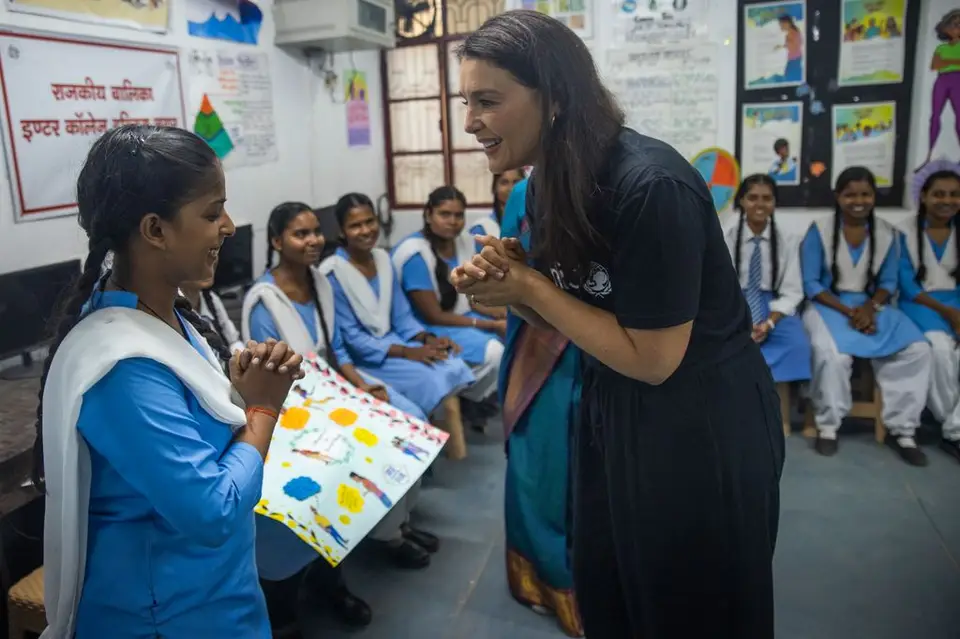
For Jessie Ware, a recent visit to India offered a reminder that confidence, self-expression and the pressures surrounding appearance can cross cultural and geographical boundaries.
The singer, broadcaster and UNICEF UK Ambassador travelled to Uttar Pradesh to meet young people taking part in the Dove Self-Esteem Project, a partnership with UNICEF designed to help children and teenagers develop confidence and navigate some of the social pressures that can shape how they see themselves.
Standing among a group of enthusiastic teenagers in a classroom, Ware found that conversations about self-esteem quickly became personal and unexpectedly universal. Although the students she met live very different lives from her own, the subjects they discussed — feeling comfortable in your identity, having the courage to speak, dealing with expectations and learning not to be overly concerned with other people’s judgments — were familiar ones.
“The children taught me so much,” Ware said of the experience, according to HELLO! Magazine, which reported on her visit.
“Our lives may look very different, but so much of what we talked about felt completely universal: wanting to feel confident in who you are, finding your voice, and not worrying too much about what other people think.”
That sense of common ground became one of the defining themes of Ware’s trip.
From the classroom to conversations about self-worth
Ware’s visit centred on interactive sessions designed to encourage young people to examine ideas around appearance, gender expectations and self-esteem.
Rather than relying solely on conventional classroom instruction, the students use creative exercises, role-play and comic books from the Aadha Full series to explore situations they may encounter in everyday life. The activities are intended to give teenagers a way of discussing subjects that can otherwise be difficult to articulate, particularly during adolescence.

For Ware, observing the students participate offered an opportunity to see those lessons in action.
“I was struck by their creativity and ambition,” she said. “Hearing that some of the boys and girls hadn’t always felt confident enough to speak up, and then seeing them bring the comic book stories to life and so openly share their experiences, was incredibly inspiring.”
The significance of that response lies partly in the age of the students. Adolescence is a period in which ideas about appearance, identity and social expectations can become especially influential. For the young people involved in the programme, the workshops provide a setting in which those issues can be discussed collectively rather than treated as private concerns.
The students’ own accounts illustrated the range of subjects being addressed.
Thirteen-year-old Gauri said the workshops had changed the way she thought about gender equality. She described learning that girls and boys should be treated equally and that activities or ambitions should not automatically be divided according to gender.
For 17-year-old Anushka, the discussions touched more directly on appearance and the judgments young people can encounter. She spoke about pressures involving body image and skin tone within the home and said the programme had encouraged her to place greater emphasis on her own development.
Those experiences demonstrate that self-esteem is not limited to one particular issue. Appearance, gender expectations, family attitudes and confidence in speaking up can overlap, shaping how young people understand both themselves and the opportunities available to them.
A lesson that followed Ayush home
One of the clearest examples of the programme’s influence came from 14-year-old Ayush.
He explained that the comic-book stories had changed his understanding of equality between girls and boys. More significantly, he connected that lesson to his behaviour at home, saying that he now helps his mother and sister with household chores because he can and because domestic work should not be regarded as exclusively a girl’s responsibility.

It is a small, everyday example, but it illustrates the way educational programmes can move beyond the classroom.
Rather than treating gender equality as an abstract principle, Ayush described applying the idea to a familiar part of family life. His account also reflects the broader aim of activities that encourage young people to question assumptions they may otherwise accept as normal.
For Ware, these moments appeared to reinforce the importance of giving young people the opportunity to speak for themselves.
During her visit to Rajkiya Girls Inter College in Indira Nagar, Lucknow, she interacted with students in a career-hub room and took part in conversations that extended beyond the formal workshop activities. One student performed Bharatnatyam, the traditional Indian dance form, for Ware, while another student later presented her with a sketch portrait.
These encounters added a personal dimension to a visit that was otherwise focused on a wider programme of youth empowerment.
Jessie Ware’s advocacy beyond music
Ware is widely known for her career as a recording artist and for Table Manners, the podcast she presents, but her public work has also included advocacy around wellbeing and positive body image.
Her role as a UNICEF UK Ambassador places her alongside the organisation’s broader efforts to promote children’s rights and wellbeing. That work gives particular relevance to a visit focused on confidence during adolescence, when young people can be navigating rapidly changing expectations about how they should look, behave and present themselves.

For Ware, the India trip also appeared to challenge any assumption that discussions about self-confidence are primarily specific to one culture.
Her observation that the students’ experiences felt “completely universal” was rooted in the conversations she had with them. The circumstances may differ, but the desire to feel accepted, to speak without fear of judgment and to develop confidence can emerge in many different settings.
That does not mean young people’s experiences are identical. Their family structures, communities, social expectations and individual circumstances can be very different. Rather, Ware’s comments point to the shared human questions that can emerge around self-worth and belonging.
The wider reach of the Dove Self-Esteem Project
The programme Ware visited forms part of a much larger international initiative.
According to figures cited by HELLO! Magazine, the global partnership between UNICEF and the Dove Self-Esteem Project has reached more than 160 million young people across 153 countries. In India alone, the partnership has reached more than 21 million children.
Those figures place Ware’s visit within a programme operating on a considerably larger scale than the individual school setting where she spent time.
Dr Philip Goodwin, Chief Executive of UNICEF UK, described the connection between self-perception and opportunity as central to the organisation’s work.
“How a child sees themselves shapes everything – whether they speak up, seize opportunities or dare to dream big,” Goodwin said in a statement reported by HELLO! Magazine.
He added that every child should have the opportunity to grow up feeling valued and heard, arguing that investment in youth wellbeing can help young people develop the confidence needed to shape their own futures.
Goodwin also pointed to the partnership with Dove as an example of organisations working together around youth wellbeing. According to the statement, the Dove Self-Esteem Project has supported millions of children in countries including India, helping them strengthen confidence and develop skills for navigating adolescence.
Why confidence can become a practical issue
The stories shared by the students also underline why self-esteem programmes can extend beyond questions of simply “feeling good” about oneself.
Confidence can affect whether a young person participates in a discussion, asks for help, pursues an ambition or challenges an assumption about what they are capable of doing. Gender expectations can influence responsibilities at home, while appearance-related judgments can affect how teenagers perceive themselves.
The students Ware met described these issues in practical terms rather than as distant concepts.
Gauri’s comments focused on equality between boys and girls. Anushka discussed appearance and family judgments. Ayush described changing his approach to household responsibilities. Taken together, their experiences show how questions about identity and confidence can appear in very ordinary parts of young people’s lives.
That was perhaps why Ware’s interaction with the students resonated so strongly. The visit was not simply about a celebrity entering a classroom. It created an opportunity for the students to demonstrate what they had learned and to discuss the pressures they encounter in their own lives.
Finding a voice
For Ware, one of the most striking aspects of the experience was watching students who had not always felt comfortable speaking up become willing to share their perspectives.
That progression — from hesitation to expression — sits at the heart of the project’s stated purpose.
The ability to find one’s voice is particularly important during adolescence, a stage when young people are beginning to form stronger ideas about who they are and how they want to be seen by others. Creating spaces where those ideas can be expressed can help make conversations around confidence, appearance and equality less isolating.
Ware’s own description of the visit suggests that she left India with as much to reflect on as the students themselves.
“The children taught me so much,” she said.
It is a fitting conclusion to a visit built around listening. The students were there to take part in lessons about confidence and self-esteem, but their willingness to share their experiences also gave Ware an opportunity to consider the common challenges that can connect people whose lives otherwise look very different.
For the teenagers involved, the impact may be found in the everyday choices that follow: speaking a little more confidently, questioning a judgment about appearance, challenging a gender assumption or taking on a responsibility that once seemed reserved for someone else.
For Ware, those moments offered a tangible illustration of what can happen when young people are given tools to understand themselves and the freedom to express what they think.
And for a programme operating across dozens of countries, the encounters in a classroom in Uttar Pradesh represent one local expression of a much larger ambition: helping young people enter adolescence with greater confidence in their own voices and their ability to shape their futures.
Source attribution: This feature is based on reporting by George Stark for HELLO! Magazine, including comments from Jessie Ware, statements from UNICEF UK Chief Executive Dr Philip Goodwin, and accounts from students participating in the Dove Self-Esteem Project in India.
The post Jessie Ware’s India Journey: Inside Her Emotional Visit With Young People Building Confidence and Finding Their Voice appeared first on Owink.
Source: Owink