
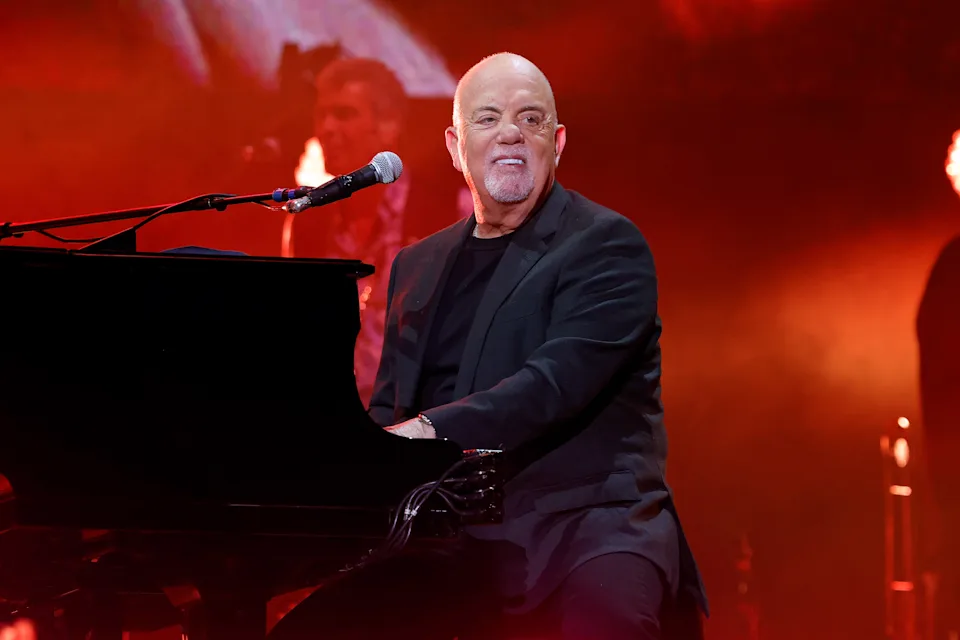
Billy Joel’s latest health update has offered a sobering glimpse into how normal pressure hydrocephalus is affecting the everyday life of one of America’s most celebrated singer-songwriters. At 77, the Piano Man singer is currently unable to drive and cannot return to live performances while he undergoes further medical evaluation, placing two long-standing passions on hold as he continues his recovery.
In an interview with The Hollywood Reporter, published on Thursday, October 15, 2026, Joel explained that driving is presently prohibited and that his return to the stage will depend on additional tests and medical advice. The update was reported by Faye James for HELLO! Magazine in a feature examining the singer’s health, recovery and decision to part with much of his motorcycle collection.
“I can’t drive right now. I’m not allowed to drive,” Joel told The Hollywood Reporter, making clear that his restrictions extend beyond the concert stage to an activity that has long formed part of his personal life.
Although the news has prompted concern among fans, Joel has not announced that he is retiring from music. Instead, his comments point to an uncertain recovery period in which medical assessments, rather than a predetermined timetable, will determine whether performing becomes possible again.
Why Billy Joel cannot currently return to the stage
For Joel, the inability to perform is particularly significant because live music has been central to his career for decades. His catalogue includes enduring songs such as Piano Man, Uptown Girl and New York State of Mind, while his concerts have brought generations of listeners together around music that has remained popular well beyond its original release periods.
However, the physical demands of a live rock performance are now a concern for his medical team. Joel explained that his neurologist had warned him about the potential impact of performing, comparing the strain of a concert to experiencing a concussion.

“The volume. Rock and roll is loud, man,” he said, describing the multiple pressures involved in appearing before an audience.
Joel explained that the concern was not limited to sound levels. Concert lighting, noise, the stress of the event, the presence of an audience and the energy required to perform all contribute to the demands placed on him.
“There’s a lot going on when you’re on stage,” he said, adding that his doctors had advised him against performing for the time being.
The distinction matters because a concert is more than simply singing a series of songs. It requires a performer to maintain concentration, coordinate movements, respond to musical cues and manage the physical and emotional demands of a sustained appearance. For someone experiencing difficulties with balance, vision or other neurological functions, those combined demands can create additional challenges.
Joel has not said that he has permanently lost the ability to perform. Instead, he explained that further testing is necessary before his doctors can determine whether returning to the stage would be safe.
He also made his desire to resume performing clear, saying that he would like to return if his medical team considers it appropriate.
For fans, that leaves an important distinction between an indefinite pause and a confirmed retirement. At present, there is no announced date for his return, and the outcome of the additional medical assessments remains unknown.
A health condition that affects more than music
Joel publicly disclosed his diagnosis of normal pressure hydrocephalus, commonly known as NPH, in 2025. The condition involves an abnormal accumulation of cerebrospinal fluid in the brain’s ventricles, the fluid-filled spaces that help protect and support the brain.
According to MedlinePlus, the US National Library of Medicine’s consumer health information resource, NPH can affect walking and balance, as well as memory and bladder control. Its effects can vary, making medical evaluation important for understanding how the condition is affecting an individual.

Joel has described balance as one of his principal difficulties. He has also discussed effects involving memory, vision and hearing, illustrating how the condition has reached beyond the specific demands of his profession.
The challenges associated with NPH are particularly relevant to activities requiring coordination and spatial awareness. Driving, for example, involves judging distances, reacting quickly to changing conditions and maintaining attention while controlling a vehicle. Even when someone feels generally well, neurological symptoms may make it unsafe to resume such activities without medical clearance.
Joel’s statement that he is not allowed to drive therefore reflects a practical restriction with consequences for his independence, not merely a change in his recreational routine.
It is important, however, not to interpret his restrictions as proof that his overall condition has deteriorated in every respect. His recent comments indicate that he has experienced some improvements following treatment, even as significant limitations remain.
In its October 15 report, ABC News, in an article by Yi-Jin Yu, also covered Joel’s update and noted that the singer had described improvements after surgery. Those reported gains provide useful context for understanding why his recovery cannot be reduced to a simple narrative of either improvement or decline.
Surgery has brought some improvements, but recovery continues
In September 2026, Joel spoke about his recovery on SiriusXM’s The Billy Joel Channel, revealing that he had undergone surgery to have a shunt implanted to treat his hydrocephalus.
A shunt is a medical device used to redirect excess cerebrospinal fluid away from the brain’s ventricles, helping to relieve the effects of fluid accumulation. Treatment decisions and outcomes depend on the individual patient’s circumstances, and surgery does not necessarily mean that every symptom will immediately disappear.
Joel reported that his memory had improved, his balance had become somewhat better and his ability to function in daily life had improved following the procedure.
He has also continued physical therapy and said he is following his doctors’ instructions.

These details offer a more complete picture than the headline alone. Although he cannot presently drive or perform, Joel has described measurable improvements in some aspects of his wellbeing. At the same time, his continuing balance problems and the need for further testing demonstrate that progress in recovery does not automatically translate into permission to resume every previous activity.
His comments also underline the uncertainty that can accompany recovery from a neurological condition. Improvement in one area does not necessarily establish that a person is ready to undertake an activity with substantial physical, sensory or safety demands.
The next stage of Joel’s recovery will therefore depend on medical assessments of his current abilities and the risks associated with returning to demanding activities. Neither the singer nor his representatives have provided a confirmed timetable for that process.
The 2025 concert cancellations marked a major turning point
Joel’s latest update follows the cancellation of all his scheduled concerts in May 2025, when his team explained that his condition had been aggravated by recent performances.
According to the announcement, the worsening symptoms had affected his hearing, vision and balance. His doctors advised him to refrain from performing while undergoing treatment and physical therapy.
The decision represented a significant interruption to a career built around live appearances as well as songwriting and recording. For an established touring artist, cancelling performances affects not only the immediate concert schedule but also the expectations of audiences who have planned to attend.

Joel acknowledged that disappointment directly in a message accompanying the cancellation announcement on his official website.
“I’m sincerely sorry to disappoint our audience, and thank you for understanding,” he wrote.
The apology reflected the relationship he has maintained with concertgoers throughout his career. His current inability to perform does not erase that history, but it does change what audiences can reasonably expect in the near future.
The subsequent surgery and reports of improvement raised hopes that treatment might help him regain some of the abilities affected by the condition. His latest comments, however, make clear that any return to the stage remains conditional.
That uncertainty is especially important in interpreting the news. Joel has expressed a wish to perform again, but the decision will depend on further medical evaluation. There is no basis to treat his comments as confirmation that concerts will resume, nor as proof that he will never perform again.
Billy Joel’s motorcycle collection heads to auction
The effects of Joel’s health restrictions are also becoming visible away from music. His inability to drive has coincided with a major decision involving another longstanding passion: motorcycles.
More than 70 motorcycles from his personal collection are scheduled to go under the hammer through Gooding Christie’s at New York City’s Javits Center on November 20 and 21, 2026. The auction house announced the sale on September 28, describing the collection as a major feature of its inaugural Retromobile New York auction.
According to Gooding Christie’s, Joel intends to use the proceeds to support The Joel Foundation, which he leads with his wife, Alexis Roderick. The sale thus connects a personal transition with the foundation’s charitable work.
The collection includes motorcycles from several manufacturers and different eras, reflecting Joel’s long-standing interest in the machines themselves. The auction house has identified examples from Ducati, BMW, Moto Guzzi, Harley-Davidson, Yamaha, Triumph, Honda and Kawasaki among the marques represented.
For Joel, the motorcycles have been more than objects to collect. His public comments about the collection emphasise the enjoyment he found in riding, customisation and the craftsmanship involved in individual machines.
The decision to sell therefore represents a change in how he will engage with an interest that has been part of his life for years. Although the auction follows his current inability to drive, it would be too simplistic to characterise every aspect of the sale as a direct consequence of his diagnosis alone. Joel has also discussed the practical reality of owning a large number of motorcycles and recognising that he can no longer ride as he once did.
In the auction announcement, he reflected on the pleasure of assembling the collection and the opportunity for other enthusiasts to enjoy it.
“I’ve loved building this collection. Now it’s someone else’s turn to hit the road,” he said, according to Gooding Christie’s.
The remark offers a glimpse of how Joel is approaching a change in his circumstances: acknowledging the end of one chapter without suggesting that the interests and experiences associated with it have lost their value.
A motorcycle with a special connection to Madison Square Garden
Among the most distinctive items in the sale is a custom-painted 1978 Triumph T140 Bonneville presented to Joel by Madison Square Garden to commemorate his 150th sold-out performance at the venue.
The motorcycle is accompanied by a matching helmet listing his appearances at the arena. According to Gooding Christie’s, the bike has a special place in the collection because it connects his enthusiasm for motorcycles with one of the most significant milestones in his performing career.
Madison Square Garden has long been associated with Joel’s identity as a New York performer. The venue’s relationship with him is particularly notable because of the extraordinary number of sold-out shows he has played there.
The Triumph consequently represents more than a collectible motorcycle. It serves as a tangible reminder of the relationship between a musician and a venue that has been closely linked to his professional story.
Its appearance in the auction also brings together the two subjects at the centre of Joel’s current circumstances: his passion for riding and the concert career that he hopes he may one day resume.
The sale will allow new owners to acquire pieces of that personal history, while the proceeds are intended to support the work of his foundation. For collectors, the motorcycles offer opportunities to own machines associated with a prominent musician; for Joel, the process marks a practical adjustment to a period in which his health has imposed new limits.
Joel reassures fans as questions about his future continue
Despite the restrictions on his daily activities, Joel has sought to reassure listeners that he remains present and engaged in his recovery.
During his September appearance on The Billy Joel Channel, he addressed the concern surrounding his health and urged fans not to assume the worst.
“I just want people to know, don’t worry about me, I’m not going anywhere,” he said. He added: “I’m here. I’m still here.”
Those remarks are an important counterpoint to the latest headlines. While the inability to drive and the uncertainty surrounding live performances are substantial developments, Joel has also reported improvements in memory, balance and everyday functioning following surgery.
His reassurance should not be mistaken for a declaration that the medical challenges are over. He continues to require physical therapy, follow medical advice and undergo further assessment before decisions can be made about returning to activities such as performing.
For audiences, the central question remains whether those improvements will eventually allow him to resume live music. Joel has made clear that he wants that possibility to remain open, but his doctors’ guidance will determine what comes next.
For now, there is no confirmed comeback date, and the singer’s immediate priorities remain recovery and managing the effects of normal pressure hydrocephalus.
His situation also illustrates a wider reality for performers whose careers depend on demanding live appearances: the ability to return is not determined by public enthusiasm alone. It depends on whether the physical and neurological demands of performing can be managed safely.
Joel’s latest update leaves his musical future unresolved, but it does not close the door on a return. His own words express a desire to perform again, while his continuing treatment makes clear that the decision must wait for further medical evaluation.
For a musician whose work has become part of the soundtrack of several generations, that uncertainty will inevitably concern fans. The clearest picture available, however, is one of a continuing recovery: some reported improvements, meaningful restrictions and a future that has yet to be determined.
The post Billy Joel Health Update: Singer Cannot Drive or Return to Performing as He Recovers From Brain Surgery appeared first on Owink.
Source: Owink