
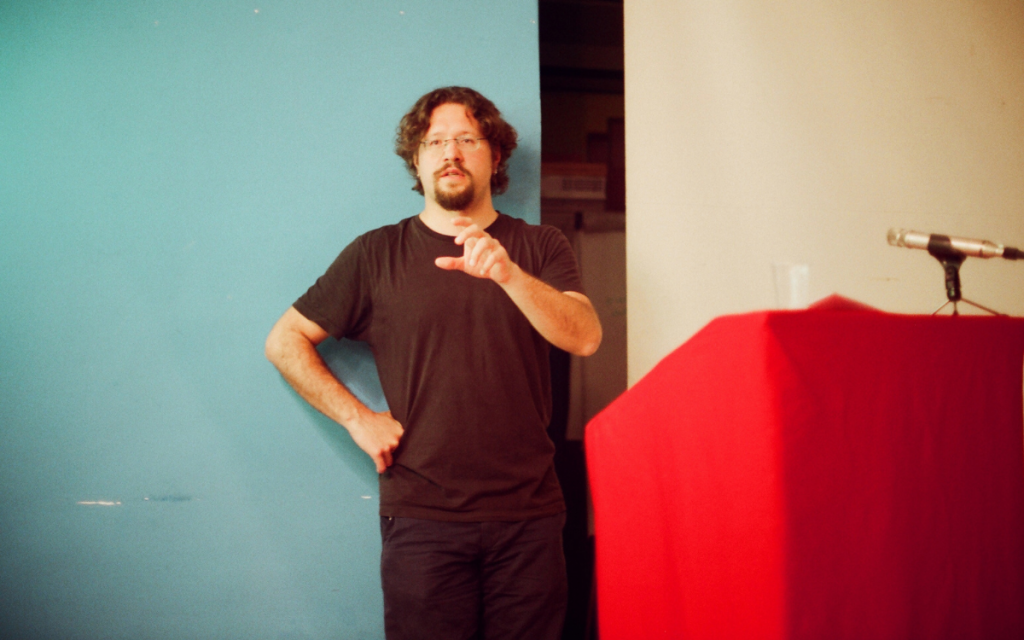
In this episode of our “The Political Construction of Artificial Intelligence” series, our guest is cultural critic, social theorist, philosopher and translator Alberto Toscano. A faculty member at the School of Communication at Simon Fraser University in Vancouver, Toscano works on Marxism, theories of “real abstraction” and value in capitalism, racial capitalism, political subjectivity, revolt and revolution, imperialism, and the politics of religion. His book Late Fascism: Race, Capitalism and the Politics of Crisis was recently published in Turkish by Dipnot Publising, translated by Şebnem Oğuz. We spoke with Toscano about the integration of artificial intelligence with war, surveillance and state apparatuses, the transformation of tech companies, the link between colonialism and fascism, and the priorities of the antifascist struggle.
Over the past year, we have seen AI become increasingly integrated into warfare, surveillance, border regimes, and intelligence systems. You have linked Palantir to the construction of what you call an “ontology layer of fascism.” As this infrastructure expands beyond US borders, how do you see the new political connections it is creating?
I borrowed the expression “ontology layer of fascism” from the critical media scholar Jathan Sadowski, who was playing on the fact that “ontology layer” is a term of art in data analytics and AI, where it refers to the formal specification of the entities, relations and rules in a particular domain that provide the semantic context for the processing of information and the production of knowledge and action – whether that domain be supply-chain logistics, medical science or the lethal targeting of civilian populations.
Palantir advertises its “decision-centric Ontology” as the “digital twin of the organization, containing both the semantic elements (objects, properties, links) and kinetic elements (actions, functions, dynamic security) needed to enable use cases of all types”. In Sadowski’s formulation, as in Moira Weigel’s reflections on Palantir’s “ontological power”, I see a welcome attention to the way in which tech companies are building software to cognitively map and logistically integrate apparatuses of domination. But I also see talk of ontology as directing us toward the materiality of the infrastructure and the fixed capital that is critical to this effort to “build to dominate” (to cite Palantir’s motto).
I think we need both to distinguish and to articulate two elements here: the first is the overt and often cartoonishly fascistic philosophy of domination voiced by the likes of Karp or Anduril’s Palmer Luckey (who recently defended Pete Hegseth’s announcement of the live-streamed execution of Nidal Hasan, the former Army psychiatrist who carried out a mass shooting at Fort Hood in 2009, by saying it was “aligned with our natural and national order”); the second is the systematic integration of this infrastructure of domination across all of our social relations, and not solely in the “repressive state apparatus.” Even if the cheerleaders of supremacy and human obsolescence fall by the wayside, self-described liberals and centrists are perfectly primed to implement and integrate this “ontology layer” into their governance.

For a long time, AI companies presented themselves as relatively independent from states. Today, however, they are becoming increasingly intertwined with defense and security apparatuses. How do you understand this transformation of technology companies?
The role of the Cold War military-industrial complex in creating the social, material and financial conditions for the emergence of a Silicon Valley tech sector permeated by a cult of individual genius and disruptive innovation has long been a leitmotif in critique of the “California ideology”. Today, it’s the founders and venture capitalists who wax nostalgic about the virtuous dynamic triggered by the belligerent nationalisation of technology. This turnabout to a sui generis statism and an open advocacy for monopolies (as in the case of Peter Thiel) could be regarded as the effort to fuse a cynical recognition of the underlying conditions for profitability with a ploy to leverage an openly imperialist nationalism to secure some legitimacy, if not among the general populace at least among governing elites. My sense is that there is a dawning awareness that the prospects for realizing the gargantuan outlays and valuations of these companies with future private and commercial consumers of AI are highly dubious.
The Economist recently reported on the nearly $1 trillion expenditure of the big US tech firms on AI infrastructure (chips, data centres, energy sources, etc.); their analysis concluded that “covering AI capex through identifiable AI income requires revenue on the order of $2.5trn per year, more than tech’s entire combined revenue today”, while the kind of productivity gains that would make AI adoption commensurate with “the largest investment surge in history” have yet to materialise (and perhaps never will). The problematic horizon for realizing this astronomical buildout of fixed capital in actual revenues, as well as the experience of successful capture of government contracts by the likes of SpaceX, makes the turn to the state eminently rational – to which we need to add the fact that as these technologies and their effects are profoundly unpopular (witness a broad-based movement against data centre construction in the US), it is not just the contracts with the government that become a matter of financial life-and-death, so does the state’s capacity through (de)regulation and repression to keep anti-Big Tech opposition at bay.
As the repressive state apparatus becomes the prized customer-of-last-resort it is also crucial to secure land, water and energy, and to quash any resistance to their appropriation for the benefit of the tech industry. The refrain of the looming China threat to US AI dominance means all of this can easily and eventually be treated as a matter of national security or as a “national emergency,” and therefore any opposition as tantamount to terrorism. Last but not least, since the telos of “superintelligence” has as its only measurable content mass unemployment and human obsolescence (when it’s not a likelihood of extinction), which perhaps suggests a limit on profitability, a kind of radically anti-democratic statism seems to be an inevitable ideological outcome.
‘For now, fascism remains electoral’
In Alex Karp’s The Technological Republic, competition with China is framed in terms of restoring the West’s technological superiority. Today, policies such as “sovereign AI” initiatives and chip export controls are justified through a similar discourse. How should we think about technological nationalism in relation to contemporary forms of fascism?
I think Jamie Merchant put it pithily in his book Endgame: Economic Nationalism and Global Decline: “As growth slows it increasingly becomes a zero-sum affair, with the gains of the few only coming at the expense of the many, and in a capitalist economy this means sacrificing the livelihood of the vast majority to the need for continuing profitability.” In other words, there are underlying systemic tendencies that operate to exacerbate interstate antagonisms and discourses of national power whether those holding the levers of governmental power have fascist proclivities or not. What I think is notable is that this nationalisation of tech supremacy has little if any traction with late fascism’s mass or electoral constituency. Techno-fascism à la Musk and Bannonite nativist “populism” (with its jeremiads against AI and tech elites) are currently precariously held together by Trump’s MAGA coalition.
JD Vance embodies the desire to bring together far-Right anti-democratic tech venture capital (Thiel) and race-baiting xenophobic nationalism, but he’s unlikely to rally the troops. The hitch is that, for now, fascism remains electoral, and technological nationalism is difficult to campaign on when it relishes the idea of automating away jobs and displacing communal and natural spaces for massive data centres, all the while advertising its contempt for everyday social life.
James William Gibson’s concept of “technowar” described the redefinition of warfare through technology and expertise. Looking at the use of AI on the battlefield today, do you still find this concept useful?
Gibson’s study, The Perfect War, was especially focused on US aerial bombing during the Vietnam war. Notwithstanding the important transformations in technology in the intervening period, I think that a number of the elements of technowar he anatomised with reference to Operation Rolling Thunder remain significant and illuminating in a context where AI technologies have been linked to the Israeli genocide in Gaza and to the Minab school massacre perpetrated by the US in its war against Iran.
Gibson saw technowar as a centralisation and managerialisation of warfare that treated soldiering as peripheral. As he put it: “United States military officers conceived of themselves as business managers rather than combat leaders. Enlisted men were seen as a kind of migrant labor force of only marginal importance.” Technowar approaches bombing as a form of communication: “Air war, then, was seen as a form of psychological warfare: the vast technocapital of air power had power far beyond physical destruction; its mere appearance was a form of power.” Its logic is one of absolute (and racialised) supremacy: “Communicative bombing is a logic of domination or torture: the foreign Other can only recognize its subordination to superior American Technowar. Within the theory, no other response is imaginable.”
And lastly, perhaps most importantly, technowar introduces a novel register of fetishism: “Whereas Marx saw the locus of fetishism and naturalization as structurally situated in the system of commodity production, this new fetishism involved rationalized capitalist production as it was organized for war production. Political and social power became conceptualized and practiced solely in terms of how high societies ranked in their ability to produce high-technology warfare. … To appropriate Marx’s phrasing, in this new fetishism definite social relationships among men assume the fantastic form of relationships among high-technology production systems for producing warfare. And when relationships appear as warfare systems, then social relationships disappear from view just as they do with the system of simple commodity production.”
I think AI has added another “layer” to a process, both real and imaginary, that transmuted human relations into “the fantastic form of relationships among high-technology production systems for producing warfare.”

From Césaire and Du Bois onward, there has been a strong tradition of thought connecting fascism to colonialism and racialized violence. How should we rethink the relationship between colonialism and fascism in “the age of AI”?
I think we could start with that ghastly crystallization of the fusion of colonial racial capitalism and techno-fascism that is evidenced by the various “reconstruction” plans for Gaza that predated the establishment of that legal and institutional abomination that is the “Gaza Board of Peace.” Particularly instructive is the Power-Point deck for one of these plans against Palestine, namely the GREAT (Gaza Reconstitution, Economic Acceleration and Transformation) Trust. I have written at greater length about these plans elsewhere (along with Brenna Bhandar), but here we can foreground that this dystopian vision for a “New Gaza,” predicated on the genocide and politicide of the Palestinian people (allowing the transition from “demolished Iranian proxy” to “prosperous Abrahamic ally”), depicts the Strip as a regional hub for trade, tourism and data.
Among the 10 mega-projects that will constellate the “Gaza-Arish-Sderot Special Economic Zone” (which include the MBS Ring Highway, The Elon Musk Smart Manufacturing Zone, and the Gaza Trump Riviera & Islands) is The American Data Safe Heaven, described as “Regional Datacenters with special US AI regulation Protected by the GREAT Trust and serving Israel and GCC through Abrahamic Infrastructure Corridor’s Fiber”. What’s more, the New Gaza’s component planned cities, designed to update the Baron Haussmann’s pioneering nineteenth-century idea of urban planning as counter-insurgency, will be based on the principle that “All services and economy … will be done through ID-based powered digital systems”.
Coupled with the use of AI in new forms of colonial and imperial warfare, I think the GREAT plan and its ilk show how seamlessly AI’s “ontology layer” is being integrated into colonial fascist rule – which toggles between the depoliticization, pacification, subordination, expulsion and the elimination of the native, depending on the twin needs of the settler’s absolute security and impunity, on the one hand, and profitable returns on (real estate, tech and fossil) capital, on the other.

We are seeing the expansion of surveillance, facial recognition, and data systems from Palestine to the US border. How do you understand the reappearance in metropolitan centers of techniques developed in colonial settings?
Following the research of critical scholars of policing like Stuart Schrader in the US or Mathieu Rigouste in France, I am sceptical of an overly linear notion of the “colonial boomerang” in which repressive techniques first tried out in the colonies are now returning to the metropole. I think the historical and political record suggests far greater multidirectionality and entanglement. As Jeanne Morefield put it in her review of Schrader’s Badges without Borders (‘Beyond Boomerang’), in the US case ‘policing was already racialized, already violent, already corrupted, and that these preexisting practices worked their way into counterinsurgency abroad and then back again.’
We should also not ignore the forms of endo-colonialism and racialization of class warfare that pervade European history (as well as histories of non-European countries). Without neglecting the specific effects of “the Palestine laboratory” on the militarization of policing and surveillance in the US or Europe, we should also not forget that the states of the Global North or West have a long history (including a pre-colonial one) of war against their own populations. The US was doing apartheid, surveillance and racial policing long before the Nakba and the foundation of the Israeli state.
Having said that, it is also clear that the more that what Alliez and Lazzarato in their Wars and Capital call “wars against populations” become an open rationale of governance (as they do in the wars against migrants but also those against protesters and dissenters across erstwhile liberal capitalist democracies), the more obvious is the fascist reduction of politics to open and permanent counterinsurgency, and thus the continuity with colonial practices past and present.
‘Fascism can often advance better with analog and rudimentary tools’
Many of the fears surrounding AI are increasingly articulated around migrants, China, and technological competition. What kind of relationship do you see between the production of fear and the defense of existing property relations in “the age of AI”?
To begin with, I wonder if perhaps we shouldn’t be cautious about treating ours as “the age of AI”, which seems to concede too much to the epochal discourse of inevitability that dominates the tech industry’s relationship to public and industrial policy. I think the production of fear and enmity is critical for the projection of fascism as the preventive counter-revolution of property (a definition fuses Angela Davis and W.E.B. Du Bois). While AI, and what scholar Donatella Della Ratta calls, writing of the political use of AI-powered visualisation, its “speculative violence,” is an important tool in cementing the nexus of fear and property, I’m not sure it has made particularly great innovations in that domain. Fascism can often advance better with analog and rudimentary tools (syntactically incoherent and crassly provocative interminable rally speeches by Trump, say) than with enormous and expensive technological refinement.
A significant part of the digital infrastructure of fascism has been built by governments and companies that are not explicitly fascist. Does this require us to think of fascism not only as an ideology or political movement, but also as a question of infrastructure?
Certainly. I understand late fascism very much as a particular use and affective politicisation of the infrastructures of accumulation, dispossession, surveillance and repression created under “neoliberal” conditions. The explicit affirmation of these infrastructures for the purposes of domination marks a phase-shift, but it should not allow us to forget the enormous violence – physical, structural, symbolic – produced and reproduced by self-described liberals, centrists or classic conservatives. Fighting overt fascism is not enough unless these infrastructures themselves are dismantled, torn up from the roots, abolished.
Behind AI lies a vast chain of labor, stretching from data workers and software engineers to data center workers and those working on public and military systems. The experiences of workers at different points in this chain are very different. Do you see a basis for the formation of a common political subject among them?
Many commentators have noted that among the several reasons for Big Tech elites’ turn to the far Right is the umbrage that they took at their employees advancing social justice issues but especially questioning their bosses’ collusion with repression and warmaking (including the Tech Workers’ Coalition protests against Palantir in 2017 and Google employees’ protests against the corporation’s work with the Pentagon’s Project Maven in 2018). But the most salient form of opposition to the power of Big Tech today originates from communities affected by data centres, not from workers within the tech sector.
The question of effective alliances across different experiences of extraction, exploitation, dispossession or disposability is an eminently political one. Can some coalitions be birthed that would span coders being made redundant by AI, the invisibilised and marginalised workers tweaking AI to appear entirely seamless (“fauxtomation”), high-level tech workers with ethical qualms at colluding with repression and state murder, and people rising up against data centres polluting, depleting or displacing their communities? I think that’s a question that can only be answered in the political practice of constructing common interests, solidarities and imaginaries.
“‘Super Intelligence’ is being sold as a kind of moonshot to dispel the spectre of American decline”
Palantir’s technologies are no longer being used only in the context of the United States and Israel. States across Europe and the Gulf are acquiring similar technologies of data processing, surveillance, and warfare, or developing their own versions. How does the global spread of these technologies alter the relationship between the center and the periphery in the technological infrastructure of fascism?
At the level of political economy, the dominance of Big Tech seems to be a factor that exacerbates the disjunctions and inequalities between “centre” and “periphery”. Of the ten top companies worldwide by market capitalization only two (Taiwan Semiconductor Manufacturing Company and Saudi Aramco, the only non-tech company in the list) are not US-based. The CEOs of these companies have clearly decided that their present and future dominance demands embarrassing shows of fealty to Trump and increasing integration into the MAGA White Houses project for perpetuating American domination (now without hegemony) ad infinitum.
AI, or rather “Super Intelligence” is being coded and sold as a kind of moonshot to dispel the spectre of American decline. And of course, this is being framed by a new AI-centred economic and geopolitical cold war with China, and its alternative “nationalisation” of AI in a more classically developmentalist and “biopolitical” key. As Cédric Durand narrates in his recent book How Silicon Valley Unleashed Techno-Feudalism, the European Union (unlike the US) drank the Kool Aid of neoliberal market fundamentalism and pre-emptively stripped itself of the planning and state capacities to compete in the AI “race”. As with the platform economies, I think we need to distinguish between the spread and use of these technologies and the kinds of economic and political power they channel and consolidate.
The Italian scholar Dario Guarascio has in this respect written of a “digital imperialism” that combines the enormous concentration of technological power, the pervasive digitalisation of the capitalist economy and an increasing centrality of warmaking both as a domain of R&D and as a geopolitical reality and horizon. As he puts it: “The militarisation of the digital industries diverts resources and knowledge from applications that could improve the human condition and enable international cooperation. The convergence between digital monopolies and the imperialist strategies of states increases inequalities, hollows out democracy and augments the risk of global conflict.”
Finally, as AI becomes increasingly integrated with the state, capital, and the apparatuses of war, which areas of struggle should anti-fascist movements prioritize?
As anti-fascist organizing and opinion becomes increasingly illegalized and subject to what Lisa Bhungalia has called the “asphyxiatory violence” of targeted economic warfare (a practice long levelled against Palestinian solidarity activism and most recently evidenced in the proscribing and debanking of the Italian anti-fascist media collective Autistici/Inventati by the US state), it is inevitable that movements will have to mobilise to defend or create the political, institutional and juridical spaces for association, inquiry and oppositional speech. But I think there is an urgent need for addressing, at multiple levels and sites, the infrastructural and “ontological” power of the fusion of tech capital with external imperialism and the internal fascisation of everyday politics.
The mass disposition to reject tech dominance evidenced by the movement against data centres is an important sign and starting point, at least in the US context. Ultimately, the socialisation and collective control of the facets or potentials of these technologies that answer to genuine social needs or contribute to human flourishing will need to be put on the agenda, which will mean breaking the power of a tech oligopoly currently being held together by state patronage, regulatory indulgence and circular financing.
Nothing short of expropriation or confiscation will be required in the face of companies whose absurd accumulation of power and wealth is predicated on the unchecked exploitation of the dead intellectual labour of centuries of human culture, the incessant and omnipresent predatory surveillance and extraction of data about our collective behaviour, and the state-enabled commandeering and abuse of the environmental and energetic resources that make the earth habitable. Perhaps the euthanasia of the rentier will need to be reinvented as the euthanasia of the founder. (DS/VC/VK)
Source: BIANET