
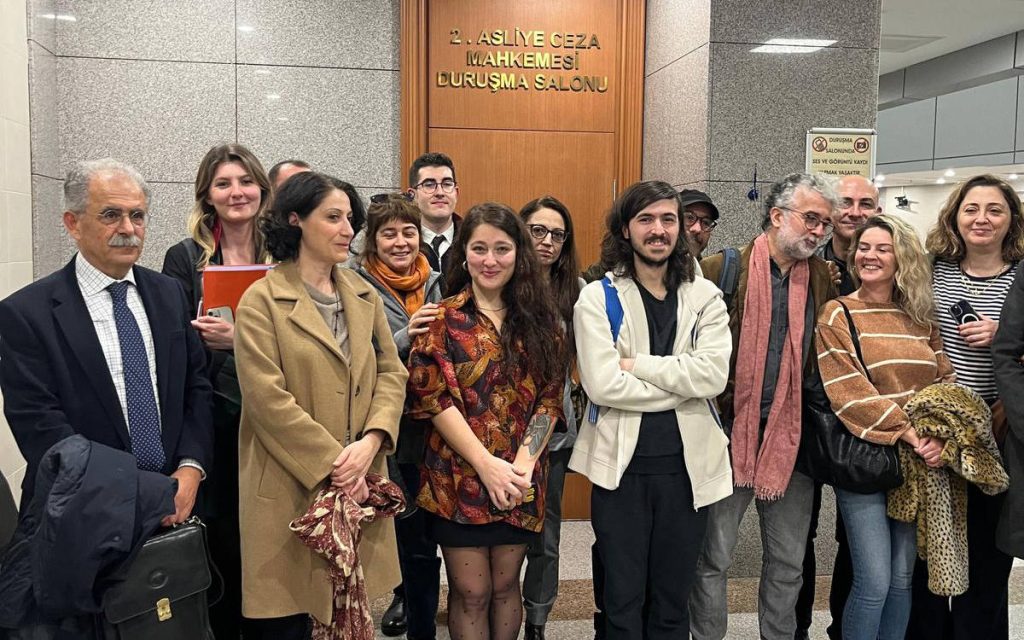
The trial of bianet editor Tuğçe Yılmaz, who is facing charges of “insulting the Turkish nation and state” under Article 301 of the Turkish Penal Code began yesterday. The charges stem from an interview Yılmaz conducted with Armenian youth.
Yılmaz was represented by lawyer Deniz Yazgan, Batıkan Erkoç, a lawyer from the Media and Law Studies Association (MLSA), and Elif Ergin, a lawyer from the Turkish Journalists’ Union (TGS) during the hearing at the İstanbul 2nd Penal Court of First Instance.
Journalists, civil society members, and representatives from freedom of expression organizations attended the hearing. Among the attendees were Onur Hamzaoğlu, a public health professor, Erol Önderoğlu, Turkey Representative for Reporters Without Borders (RSF), and Özgür Öğret, Turkey Representative for the Committee to Protect Journalists (CPJ).
Before the trial began, the judge removed a number of spectators who were unable to find seats in the courtroom, citing the small size of the room and inadequate ventilation. The session proceeded after identity checks.
Yılmaz criticizes ‘lack of legal basis,’ remembers Hrant Dink
During her defense against the indictment, Yılmaz stated, “The reason I am here today is because, as a journalist, I exercised my legally protected freedom of speech, only to be reported to CİMER [Presidential Communication Center].”
She suggested that the complaint was likely made by an individual who was uncomfortable with the coexistence of diverse societal groups, possibly with racist tendencies, due to the controversial topic of the Armenian Genocide. Yılmaz also discussed the timing of the case, noting that the legal window for filing a lawsuit had passed before the case was brought to court. She described the circumstances of her detention, saying, “While on my way home, I was stopped by the police and spent a night in detention on suspicion of attempting to flee. I later found out that I was being tracked by a facial recognition system, like something out of a crime drama.”
Yılmaz emphasized the impact of the ongoing peace talks with Armenia, noting that Armenian Prime Minister Nikol Pashinyan had recently visited Turkey at the invitation of the President, and discussions about opening border gates and resuming trade between the two countries were underway.
She continued, “I want to make it clear that what is being judged here is my profession, which I have pursued with excitement and curiosity since 2015. As someone simply trying to practice my profession better, I believe there is no legal basis for my prosecution under such a vague and controversial article.”
Referring to the accusation against her, Yılmaz stated, “I did not insult anyone. On the contrary, I have always listened to those in this society who feel marginalized.” She concluded her remarks by remembering Hrant Dink, the journalist who was also prosecuted under Article 301 and later assassinated. Yılmaz called for her acquittal.
‘Prices were paid because of article 301’
Next, lawyer Yazgan took the floor. He began by referencing an example involving CİMER complaints. “If my neighbor were to abuse his wife, and I anonymously reported it to CİMER, I would be told, ‘This is the responsibility of the Public Prosecutor’s Office. Please file a report with the Prosecutor’s Office,’” Yazgan explained, adding, “I cannot report a man’s violence through CİMER, but with the concept of ‘genocide,’ a term that has been declared not to constitute a crime through countless acquittals and rulings by the Constitutional Court and the European Court of Human Rights, investigations can still be launched and lawsuits can be filed. This, for journalists, amounts to a form of judicial harassment meant to intimidate us.”
Yazgan further criticized the prosecutors for their knowledge of the law, emphasizing that they are aware of the restrictions on arrests and that the law prohibits taking statements two days after an indictment. “Article 2 of the Constitution is clear: the Republic of Turkey is a state of law. This ongoing string of legal violations is incompatible with the constitutional order. Great costs have already been paid in this country due to Article 301. We do not want to see new costs added,” he said, referencing landmark decisions like Dink v. Turkey and Akçam v. Turkey.
Yılmaz’s legal team demanded her immediate acquittal.
‘CİMER complaint cannot be the basis for legal action’
Attorney Batıkan Erkoç also addressed the court, pointing out that the case was filed after the legal period for initiating a lawsuit had expired. He explained that the timeline for the case was based on a report from the police, which was not a valid legal foundation for starting proceedings. “This has no serious basis,” he argued.
Erkoç also stressed that the complaint filed through CİMER was legally invalid. “The law requires a petition with identifiable information, and an anonymous complaint cannot be accepted. The law specifies how petitions should be written, including the name, surname, request, and address of the individual submitting it,” he stated.
Erkoç called for the case to be dismissed without proceeding further.
The judge, however, disagreed with the defense’s requests and instructed the prosecutor to prepare a final opinion on the case. The prosecutor requested more time to prepare, and the court granted the request. The next hearing will take place on Apr 21 at 2:30 p.m. (HA/VK)
Source: BIANET