
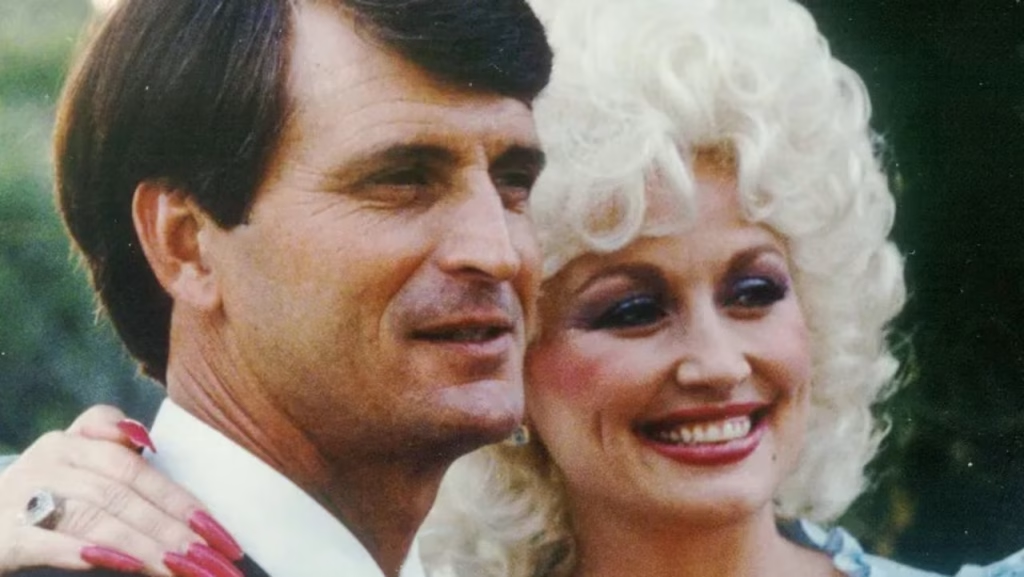
When Dolly Parton died at 80, the world was reminded not only of the extraordinary scale of her career but also of the remarkable stories embedded in her songwriting. Among the most enduring is “Jolene,” the 1973 country classic in which a woman pleads with another woman not to take the man she loves.
On the surface, “Jolene” sounds like a portrait of romantic panic: a vulnerable narrator confronting a woman whose beauty appears almost impossible to compete with. But the song’s origins were considerably more complicated — and, according to Parton herself, rooted partly in a real episode involving her husband, Carl Dean.
The story has long fascinated fans because the woman who inspired the song was not actually named Jolene. Instead, Parton combined the real-life circumstances surrounding a flirtatious bank teller with the name and appearance of a young fan she encountered at one of her performances.
The result was a song that transformed an ordinary moment of marital jealousy into one of the most recognizable pieces of songwriting in country music.
The real woman behind “Jolene”
Parton explained the origins of the song in a 2008 interview with NPR, saying that a bank teller had developed what she described as a serious crush on Dean, whom Parton had married in 1966.
“She got this terrible crush on my husband,” Parton told NPR. She also recalled that Dean enjoyed the attention he received at the bank, turning the situation into something of an inside joke between the married couple.

Parton’s response was not simply anger. She turned the situation into material for a song.
She joked with Dean about spending so much time at the bank, even teasing that she did not believe they had enough money to justify his frequent visits. In Parton’s telling, the episode was ultimately innocent, even though the song that emerged from it sounded far more dramatic.
That contrast is central to understanding “Jolene.” The song presents the emotional stakes of infidelity without necessarily documenting an actual affair.
Parton herself characterized the circumstances as innocent, despite the threatening emotional landscape suggested by the lyrics. Her account therefore offers a different picture from the literal scenario presented in the song: the drama was part of the storytelling, while the original incident was something the couple could joke about.
So who was Jolene?
The name came from somewhere else entirely.
Parton told NPR that she once met a young red-haired girl who approached her after a performance and asked for an autograph. The child had striking red hair, beautiful skin and green eyes, and when Parton asked her name, she answered, “Jolene.”
The name immediately caught Parton’s attention.

She repeated it to herself, recognizing that it sounded like a song title and a memorable name for a character. That encounter eventually supplied the identity for the woman at the center of the song.
This means that “Jolene” was effectively built from two different real-life inspirations: the circumstances came from the bank teller who flirted with Carl Dean, while the name came from a young fan Parton encountered at a show.
That distinction is important because it prevents one of country music’s most famous songs from being treated as a straightforward account of a single woman.
The Jolene of the song was a creative construction, assembled from details Parton encountered in everyday life.
Dolly Parton turned jealousy into vulnerability
Part of the song’s enduring power comes from the fact that its narrator does not approach Jolene with anger or superiority. Instead, she begs.
That emotional position was closely connected to Parton’s own admission that other women could make her feel insecure.
In discussing the woman who had attracted Dean’s attention, Parton described her as possessing physical qualities she felt she lacked. The woman was tall and striking, while Parton presented herself with her characteristic self-deprecating humor.

Parton also observed that women can feel threatened by other women regardless of how confident they may otherwise be.
That vulnerability became one of the defining characteristics of “Jolene.” The narrator is not claiming that she is entitled to Dean’s affection simply because she is his wife. She is acknowledging the possibility that someone else might be more beautiful, more imposing or more alluring — and asking that person to show mercy.
It is a remarkably exposed emotional premise for a major country hit.
Rather than portraying jealousy as righteous indignation, Parton made it sound like fear.
A song that became much bigger than its original story
“Jolene” arrived during one of the most productive periods of Parton’s early solo career.
The Country Music Hall of Fame notes that the early-to-mid-1970s represented a particularly fertile period for her songwriting. In 1974, “Jolene,” “Love Is Like a Butterfly” and “I Will Always Love You” all reached No. 1, helping establish Parton as a major solo artist beyond her work alongside Porter Wagoner.
The song was released as a single in 1973 and became one of the defining recordings of her career. Its influence has continued long after its original country success, with artists from different generations and genres interpreting the song for new audiences.
The Recording Academy inducted “Jolene” into the Grammy Hall of Fame in 2014, formally recognizing its lasting historical importance.
That longevity is striking because the song itself is built on an unusually simple premise.
There is no elaborate plot. There is no complicated cast of characters. There is simply a woman, her husband and the fear that another woman might take him away.
Yet Parton’s writing makes that narrow situation feel universal.
Carl Dean’s role in the story
Carl Dean occupied a curious place in Parton’s public life.
The couple met in Nashville in 1964, shortly after Parton moved to the city, and married two years later. Their relationship lasted nearly six decades, but Dean deliberately remained far removed from the entertainment spotlight.
That privacy often made him a subject of public curiosity, particularly because Parton was one of the world’s most recognizable entertainers while Dean largely avoided public appearances.
Dean died in March 2025 at age 82. The Los Angeles Times reported that the couple had been married for nearly 60 years and that Parton’s publicist confirmed his death.
His connection to “Jolene” therefore became part of the broader story of a marriage that was simultaneously highly public through Parton’s career and intensely private through Dean’s choices.
The song also illustrates how little of a long marriage can necessarily be understood from one famous story. A listener encountering “Jolene” without knowing its history could easily assume that it documents a serious marital crisis. Parton’s own explanation paints a more playful picture of the incident that inspired it.
What Parton said about their marriage
Parton also addressed the couple’s approach to relationships over the years, describing what she called an “open relationship” while making clear that she meant something different from a sexually open marriage.
In her account, both she and Dean could flirt with other people, but neither was supposed to take those interactions further. Parton described herself as someone who enjoyed flirting and said Dean understood that aspect of her personality.

She also maintained that the couple loved one another deeply.
That context helps explain why Parton could transform a potentially uncomfortable episode into a song without necessarily presenting it as evidence that her marriage was collapsing.
The existence of rumors surrounding the couple’s private lives likewise did not change Parton’s public account of their relationship. Over the years, she rejected claims that she had been romantically involved with her longtime friend Judy Ogle, emphasizing that their relationship was a close friendship dating back to childhood.
The distinction between friendship, flirtation, rumor and actual infidelity was something Parton repeatedly addressed in her own words.
Why “Jolene” still resonates
The song’s continued appeal is partly explained by how little listeners need to know about Parton or Dean to understand its emotional core.
Jealousy is immediate. So is insecurity.
The narrator sees another woman as a threat and imagines losing the person she loves. That fear does not require a specific decade, celebrity marriage or country-music setting. It can be understood by anyone who has experienced romantic uncertainty.
That universality has allowed “Jolene” to travel far beyond its original audience.
The song has been recorded and performed by numerous artists, while later interpretations have demonstrated how flexible Parton’s writing can be. Its basic structure can be reimagined without losing the emotional tension at its center.
The song’s cultural reach was also reflected in Beyoncé’s 2024 reinterpretation, while other artists including The White Stripes have brought their own approaches to the material.
For a song that began with a bank visit and a joke between spouses, its cultural afterlife has been extraordinary.
The genius of Parton’s version of the truth
There is perhaps a larger lesson in the story of “Jolene.”
Parton did not simply reproduce what happened. She transformed it.
A bank teller’s interest in her husband became the emotional foundation. A young girl’s memorable name became the identity of the imagined rival. Parton’s own insecurities supplied another layer, and her songwriting turned all of those elements into a dramatic plea.
That is the difference between a personal anecdote and a great song.
The real woman who inspired the situation was never actually Jolene. The young fan who supplied the name was not the woman flirting with Dean. And the marriage described by the song was not necessarily the marriage that existed in reality.
Instead, Parton used fragments of real life to construct a fictional confrontation that felt emotionally authentic.
It was a technique that served her throughout her career. Her songwriting frequently drew from family, relationships, childhood memories and ordinary encounters, transforming personal experiences into stories that could belong to much larger audiences.
“Jolene” may have begun with a moment of jealousy, but it ultimately became something more enduring: a portrait of vulnerability disguised as a country song.
And after Parton’s death, that story carries a new resonance. The woman who once joked that she had a bank teller to thank for one of her greatest songs left behind a catalog in which real life and imagination were repeatedly intertwined.
The irony is that the original episode was, by Parton’s own description, relatively harmless. The song it inspired was anything but.
That tension — between the ordinary reality and the extraordinary story created from it — is precisely what has kept Dolly Parton’s “Jolene” alive for more than half a century.
The post Dolly Parton’s “Jolene”: The Real Story Behind the Hit, Carl Dean and the Woman Who Inspired It appeared first on Owink.
Source: Owink