
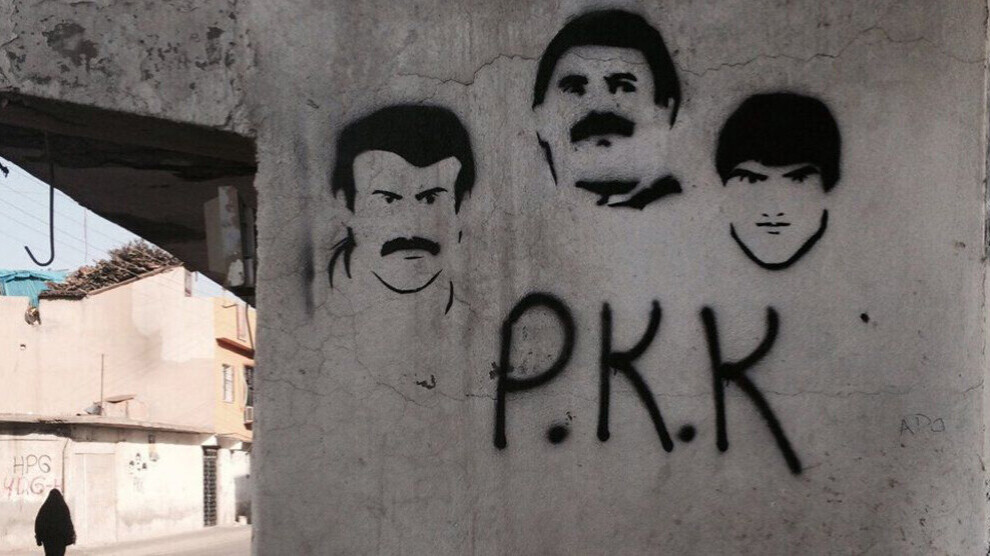
Hunger strikes are one of the few political tools that prisoners have to express their resistance. They’re not just an act of refusal, but a symbolic way to stand up for yourself—an expression of dignity, determination, and steadfastness against injustice.
After the military coup of September 12, 1980, which was carried out under the pretext of saving the “unity and welfare of the nation” and was accompanied by massive repression against left-wing and Kurdish movements, thousands of activists, workers, and intellectuals were arrested. Some of them ended up in the notorious military prison in Diyarbakir. Founding members of the Kurdistan Workers’ Party (PKK) were also taken to this prison—a place that has gained sad notoriety in history as the “Hell of Amed.”
What awaited the prisoners there was a system of deliberate dehumanization. Torture, sexual violence, coercive measures aimed at assimilation—in particular the ban on the Kurdish language—and psychological abuse characterized everyday life in the prison. The aim was to break the prisoners, not only physically but also ideologically. Their identity, their history, and their political convictions were meant to be erased.
But the will to assert themselves was stronger. Hunger strikes became the prisoners’ most important form of protest. They were directed against the introduction of so-called uniform clothing, which was seen as a symbol of complete submission. One of the first to refuse total submission was Mazlum Doğan, a PKK cadre. On March 21, 1982—the Kurdish New Year festival of Newroz—he lit three matches in his cell, placed them on the table, and committed suicide. He left behind the words: “To give up is betrayal—resistance brings victory.”
Dogan’s action was a signal. On May 18, 1982, four more PKK prisoners—Ferhat Kurtay, Eşref Anyık, Necmi Öner, and Mahmut Zengin—set themselves on fire. Two months later, on July 14, 1982, key PKK leaders Mehmet Hayri Durmuş, Kemal Pir, Akif Yılmaz, and Ali Çiçek went on a hunger strike to death. They demanded an end to torture, mistreatment, and forced discipline. However, their protest was not directed solely against the conditions in prison—it was also an appeal to society beyond the prison walls, a signal to the villages, cities, and movements: the resistance lives on.
Kemal Pir, a Laz from Gümüşhane and a staunch internationalist, died after 55 days. He was followed by Mehmet Hayri Durmuş, Akif Yılmaz, and Ali Çiçek. July 14 went down in history as a turning point in the Kurdish movement – as the day of great resistance. Two years later, on August 15, 1984, the PKK launched its armed struggle in Eruh, Siirt.
Since then, the death fast has been referred to by the PKK as the “great resistance of July 14”.
The introduction of uniform clothing was abolished in 1986 following determined resistance. The era of the notorious camp commander Esat Oktay Yıldıran in the hell of Amed also came to an end. His name remains synonymous with torture in Turkey to this day. Yıldıran, who had already attracted attention for his atrocities during the invasion of Cyprus in 1974, was killed by PKK members in Istanbul in 1987. Before firing the fatal shot, the gunman said, “Laz Kemal sends his regards.”
A central figure in the prison resistance was Sakine “Sara” Cansız, co-founder of the PKK. She survived twelve years in prison despite cruel torture, which she describes in her memoirs as systematically sexualized. In Diyarbakır military prison, she became a symbol for fellow prisoners of all genders. Yıldıran is said to have once yelled at her, whereupon she spat in his face: “Who are you that I should stand at attention before you! I will not bow to the executioners!”
In January 2013, Sara was shot dead in Paris by an assassin working for the Turkish secret service MIT, along with her companions Fidan Doğan (Rojbîn) and Leyla Şaylemez (Ronahî). But their legacy and that of those who fell on July 14 lives on—in collective memory, in political practice, and in a resistance that could not be extinguished by walls or violence.
Source: ANF News