
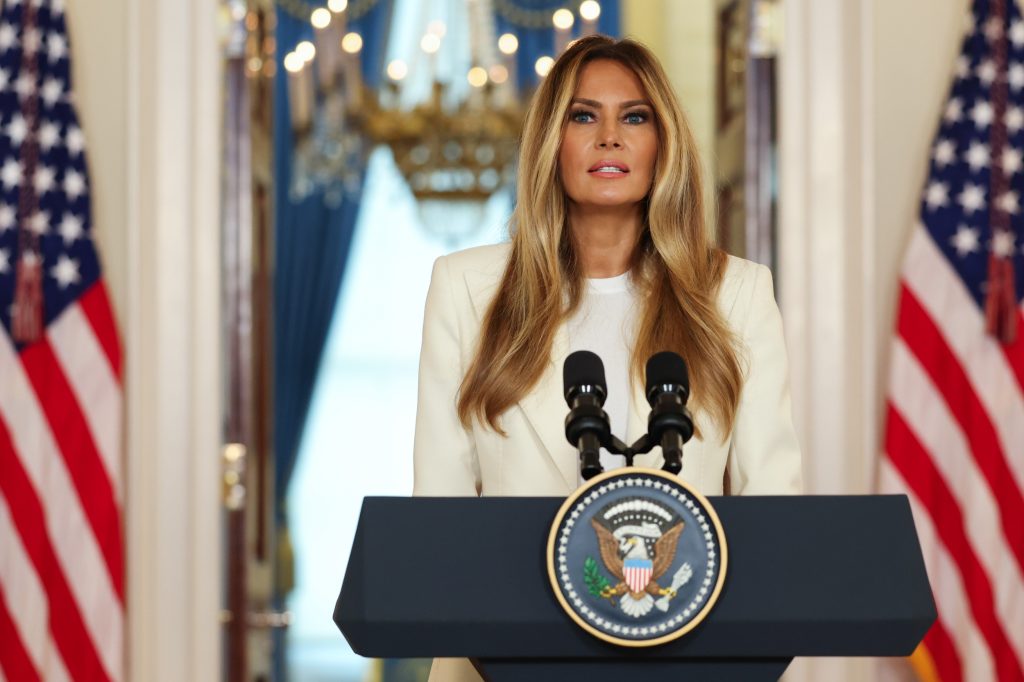
Melania Trump has received one of Ukraine’s most distinguished state honors following her involvement in securing a temporary ceasefire between Russia and Ukraine, an initiative that enabled humanitarian assistance to reach civilians and helped hundreds of residents leave the embattled city of Oleshky.
The United States first lady was presented with Ukraine’s Order of Princess Olga, First Class, on November 5, 2026, during a gathering of Russian and Ukrainian representatives at the White House. The recognition acknowledged her role in facilitating an agreement that temporarily suspended military operations in the southern Ukrainian city to create an opportunity for humanitarian relief and civilian evacuation.
The development marks a notable moment in Melania Trump’s public engagement with the conflict, extending humanitarian work she had previously undertaken to help reunite children separated from their families during the war.
According to Alexandra Hurtado’s November 6 report for HELLO!, the first lady was involved in multiple stages of the Oleshky operation, from reviewing demining plans and aerial images to assessing road conditions and discussing evacuation routes. The White House subsequently described the initiative as an unprecedented diplomatic undertaking by an American first lady.
A diplomatic initiative focused on civilian protection
The circumstances behind the ceasefire reflected the increasingly difficult humanitarian conditions in Oleshky, a city in Ukraine’s Kherson region that has remained under Russian occupation.
Before the full-scale Russian invasion, Oleshky had a population of approximately 24,000. By October 2026, the White House estimated that between 1,700 and 2,000 people remained in the city. Most were older residents who had been unable to leave, alongside approximately 50 children.

The city’s location across the Dnipro River from Ukrainian-held Kherson has placed it within a particularly challenging area of the conflict. Residents have faced the consequences of prolonged military activity, damaged infrastructure, restricted access to essential services and dangerous travel conditions.
The destruction of the Kakhovka Dam in June 2023 also had serious consequences for communities across the region. According to the White House’s October 23 background statement, approximately 90 percent of Oleshky’s territory was flooded following the dam’s destruction.
Against this backdrop, the prospect of delivering food, medicine and clean water while establishing a safe route for civilians to leave became the central objective of the proposed ceasefire.
The White House announced on October 23 that Russia and Ukraine had agreed to temporarily suspend military operations in Oleshky. The arrangement was scheduled to begin on October 29 and was intended to provide a window for humanitarian supplies to enter the city and for residents wishing to leave to receive coordinated assistance.
Melania Trump had initiated discussions with both countries and worked through her representative, Marc Beckman, to establish the terms of the operation. Her office identified her formal role as an “Exclusive Intermediary,” with the agreement’s objectives, procedures, timing and implementation discussed with Russian and Ukrainian representatives.
In its October announcement, the Office of the First Lady explained that the arrangements included civilian representatives visiting residents to establish their humanitarian needs. Those wishing to evacuate would receive transportation and support to reach their preferred destinations, whether in Russia or Ukraine.
The initiative also involved discussions about demining, road accessibility, hospital access, vehicles and medical resources. These practical considerations were particularly important because an evacuation from an active conflict zone requires more than an agreement to temporarily stop fighting. Safe passage depends on coordination between the parties, the condition of roads, the identification of hazardous areas and the availability of transport and medical assistance.
Nearly 800 people evacuated from Oleshky
The temporary ceasefire produced a significant humanitarian outcome. According to the White House’s November 5 account, nearly 800 people were evacuated from Oleshky during the operation.
Food, clean water and medicine also entered the affected area, providing temporary relief to residents who had endured prolonged shortages and insecurity.
The evacuation was not simply a matter of transporting people away from danger. Residents had different circumstances, needs and preferences regarding where they wanted to go. Some sought to reach relatives, while others needed medical assistance or a safer environment in which to continue their lives.

The White House said the operation included an impartial American media organization tasked with documenting the process and helping ensure that residents’ wishes were respected. At the November 5 gathering, Melania identified Newsmax as the organization whose journalists had entered the region to cover the humanitarian mission.
The ceasefire lasted six days and subsequently expired. Reuters reported on November 2 that Ukraine had evacuated another 167 civilians, including 22 children and 21 people with limited mobility, from threatened areas of the Kherson region as the local truce ended. The report also noted that nearly 800 residents had left Oleshky on Saturday, with evacuees travelling through Crimea to Russia before some continued towards Ukraine through Belarus.
The distinction between the wider regional evacuation and the Oleshky operation is important when assessing the figures. The temporary agreement created a limited humanitarian opportunity rather than ending the conflict or establishing a permanent security arrangement.
Reuters also reported that Ukrainian officials said both sides had honoured their commitments during the operation and that further humanitarian cooperation was being explored. Fighting continued elsewhere in the region, illustrating the limitations of a localized ceasefire within a much larger war.
Ukraine recognizes Melania Trump with its Order of Princess Olga
The diplomatic and humanitarian developments formed the backdrop to the presentation of the Order of Princess Olga, First Class.
The distinction was presented to Melania by Ukraine’s Human Rights Ombudsman, Dmytro Lubinets, during the November 5 White House gathering. The White House identified the award as President Volodymyr Zelenskyy’s recognition of her leadership in securing the Oleshky ceasefire.
The Order of Princess Olga is a Ukrainian state decoration named after Princess Olga, a historical ruler of Kyivan Rus. It recognizes distinguished service and achievements by women in public, professional and humanitarian life.

Its three classes distinguish levels of recognition, with First Class representing the highest degree of the order.
For Melania, receiving the decoration placed her humanitarian engagement with Ukraine in a formal context of international recognition. It also highlighted the unusual nature of the initiative: a sitting American first lady had personally helped bring representatives of two countries at war into an arrangement designed around the immediate protection of civilians.
Dressed in white for the White House event, Melania thanked Zelenskyy and the Ukrainian people for what she called the highest honor, expressing particular gratitude to Lubinets for presenting it.
Her remarks emphasized that the ceasefire depended on cooperation from both Russian President Vladimir Putin and Ukrainian President Volodymyr Zelenskyy.
“Their cooperation establishes a meaningful precedent for advancing peace throughout the region,” she said.
She also commended both sides for their good-faith efforts to establish and implement the different components of the agreement, expressing hope that the experience in Oleshky would encourage further efforts to reduce civilian suffering.
A White House meeting brings Russian and Ukrainian representatives together
The November 5 ceremony was significant beyond the presentation of the Ukrainian decoration.
Melania convened Russian and Ukrainian representatives at the White House, bringing together officials who had participated in the negotiations and implementation of the Oleshky ceasefire.
According to the White House, the gathering was believed to be the first occasion in American history on which a first lady had personally brought representatives of two nations actively at war together at the presidential residence for diplomacy.
Among those attending were Kirill Dmitriev, a special envoy to Putin, and Ukrainian representatives including Davyd Arakhamia, parliamentary faction leader of the Servant of the People party. Lubinets was also present.
The meeting provided an opportunity to acknowledge the cooperation that had made the localized humanitarian arrangement possible. It also allowed the participants to discuss the broader significance of maintaining communication between opposing sides when civilians face immediate danger.
Melania’s speech focused on the human consequences of the conflict rather than military or territorial questions. She described the importance of allowing children to grow up without the constant threat of missiles, drones and landmines, arguing that the lives of civilians should take precedence over the divisions created by war.
She also stressed that a temporary halt in fighting should not be treated as the final objective.
“Together, we can create something more enduring than a temporary ceasefire,” she said.
Her remarks presented Oleshky as a starting point for further cooperation, rather than evidence that a broader peace agreement had been achieved.
That distinction remains important. The arrangement addressed a specific humanitarian emergency in a defined location. It did not resolve the wider military conflict, settle territorial disputes or establish a permanent ceasefire between Russia and Ukraine.
Nevertheless, the operation demonstrated how limited cooperation can become possible even when the broader political and military relationship between two countries remains deeply hostile.
Building on earlier efforts to reunite Ukrainian and Russian children
Melania Trump’s involvement in Oleshky also followed an earlier humanitarian initiative focused on children separated from their families during the Russia-Ukraine war.
In August 2025, she wrote a letter to Putin, referred to as her “Peace Letter,” raising the issue of children affected by the conflict and the importance of restoring family connections.
Her subsequent work helped establish communication channels involving representatives from Russia and Ukraine. These channels later became part of the groundwork for discussions surrounding the Oleshky humanitarian operation.
According to a White House statement issued on August 17, 2026, Melania’s efforts had facilitated the reunification of 34 children and their families since the letter was sent.
The first lady had previously emphasized that ensuring the safe return of children to their loved ones remained a priority.
In December 2025, she said her commitment to securing family reunifications was unwavering. She also credited Russian and Ukrainian leadership with maintaining diplomatic engagement on the issue.
She described the cooperation as a source of optimism and expressed hope that continued humanitarian collaboration could contribute to broader regional stability.
The child-reunification initiative and the Oleshky ceasefire address different humanitarian challenges, but both have relied on communication between parties that remain on opposing sides of the war.
The earlier work established a channel for discussing individual cases involving separated families. The later initiative applied a similar emphasis on practical cooperation to the protection and evacuation of civilians in an occupied city.
The wider significance of a first lady’s humanitarian diplomacy
The Order of Princess Olga recognition also draws attention to the evolving public role of American first ladies in international affairs.
Although first ladies do not hold elected executive office or exercise the formal foreign-policy powers of the president, they can use their public positions to draw attention to humanitarian concerns, support diplomatic initiatives and maintain engagement with international organizations and foreign representatives.
Melania’s approach in this instance has involved direct communication through a designated representative, engagement with Russian and Ukrainian officials and a focus on humanitarian objectives.
The White House’s description of her role as an “Exclusive Intermediary” reflects the specific arrangement established for the Oleshky operation. It should not be confused with a formal appointment as a government diplomatic negotiator or with authority to negotiate a comprehensive peace agreement on behalf of the United States.
The distinction between humanitarian engagement and formal state diplomacy is especially relevant in a conflict involving major questions of sovereignty, territorial control and international security.
The Oleshky initiative nevertheless offers an example of how a narrowly defined humanitarian objective can create room for cooperation. Allowing food and medicine to enter a vulnerable city and enabling civilians to leave did not require the two governments to resolve their wider disagreements first.
Whether this model can be replicated in other locations remains uncertain. The success of any future arrangement would depend on the willingness of the parties to cooperate, the security conditions on the ground and the ability to guarantee safe passage for civilians.
Melania Trump calls for a lasting path towards peace
In her November 5 address, Melania returned repeatedly to the idea that significant change can begin with a relatively small achievement.
“Every significant transformation begins with a small spark,” she said, describing the Oleshky operation as an opportunity to build something more substantial through shared concern for innocent people.
She encouraged the representatives to use the cooperation achieved during the ceasefire as a foundation for further dialogue.
Her closing message emphasized hope, cooperation and the possibility of creating something more enduring than a temporary suspension of military activity.
The first lady also presented letters she had written to Putin and Zelenskyy, asking the Russian and Ukrainian representatives to deliver them to their respective presidents.
The gesture extended the communication-focused approach that had characterized her earlier work on child reunifications and the subsequent humanitarian negotiations.
For Ukraine, the Order of Princess Olga, First Class, formally recognized Melania Trump’s contribution to an operation that helped deliver humanitarian supplies and enabled hundreds of civilians to leave a dangerous environment.
For the first lady, the award marked another milestone in a humanitarian initiative that has increasingly involved direct engagement with representatives of both Russia and Ukraine.
Oleshky’s temporary ceasefire has ended, and the wider war remains unresolved. Yet the evacuation demonstrated that even amid continuing hostilities, limited cooperation can make a tangible difference to civilians caught in the conflict.
Melania’s central message at the White House was that such cooperation should not end with one operation. Her hope is that the humanitarian efforts in Oleshky can become a starting point for a broader commitment to peace and the protection of innocent lives.
The post Melania Trump Receives Ukraine’s Order of Princess Olga After Historic Russia-Ukraine Ceasefire Initiative appeared first on Owink.
Source: Owink