
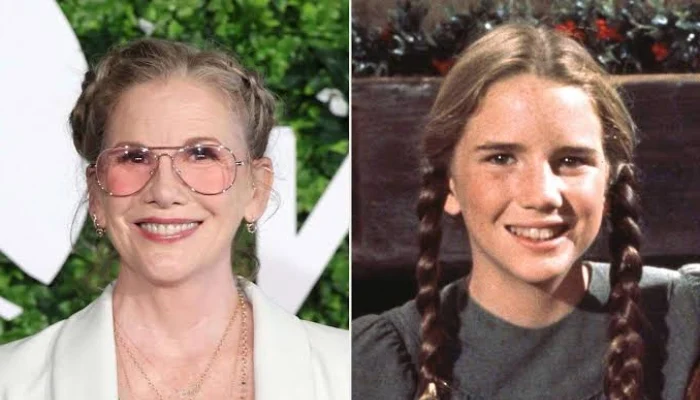
Melissa Gilbert has spent decades being recognised for her role as Laura Ingalls on Little House on the Prairie, but an unexpected piece of television memorabilia has given the actress a new reason to revisit her childhood on the beloved series. A vintage Halloween costume inspired by her character has resurfaced, prompting Gilbert to laugh at an interpretation of her face that she clearly found difficult to recognise.
The actress, now 62, shared a photograph of the costume on Instagram, offering fans a look at a piece of pop-culture merchandise that attempted to transform the young television star into a ready-made Halloween character. The outfit included a floral pioneer-style smock and a plastic mask designed to resemble Gilbert during her years on the family drama.
Rather than treating the discovery as a straightforward nostalgic moment, Gilbert responded with characteristic humour. The costume’s questionable resemblance to the actress became the centre of the joke, turning an old piece of merchandise into an entertaining reminder of how television fame could extend far beyond the screen.
According to HELLO!, which reported on Gilbert’s Instagram post on October 24, 2026, the actress recalled encountering the costume while trick-or-treating as a child. Her reaction was both amused and bewildered, particularly when she considered the mask’s resemblance to another television personality.
“Wow, could Lou Ferrigno be my birth father?” Gilbert joked.
Ferrigno, best known for playing the Hulk in the television series The Incredible Hulk, became an unexpected reference point in Gilbert’s assessment of the costume. The comparison gave her post an additional layer of humour, suggesting that the mask’s interpretation of her features had produced a resemblance she had not anticipated.
Her response captured the unusual experience of seeing one’s childhood image transformed into a commercial product. Although the costume was intended to evoke Laura Ingalls, the finished mask appeared to leave Gilbert unconvinced that it had successfully captured her likeness.
Melissa Gilbert’s vintage Halloween costume sparks a wave of fan reactions
Gilbert’s post quickly became an opportunity for fans to share their own reactions to the unusual piece of television memorabilia. The actress approached the situation with a mixture of amusement and mock disbelief, while followers joined in by offering their own explanations for how the mask might have been produced.
One commenter joked that someone at the factory had simply decided to “put braids on the leftover ‘Six Million Dollar Man’ masks.” The remark suggested that the costume’s face might have looked more like a repurposed television-character mask than a carefully modelled likeness of Gilbert.
The joke resonated with the broader appeal of vintage Halloween merchandise, particularly products associated with familiar television programmes and the celebrities who appeared in them. Such items were designed to let children step into the roles of recognisable characters, often relying on a combination of inexpensive clothing, plastic masks and a few instantly identifiable details.

In this case, the costume’s floral outfit and pioneer-inspired styling offered a recognisable reference to Laura Ingalls. The mask, however, became the feature that captured the most attention, demonstrating how a product intended to celebrate a television star can acquire an entirely different appeal decades later.
Gilbert’s own caption reflected that contrast. She offered a tongue-in-cheek acknowledgement of the manufacturer’s interpretation, before closing with a line that summed up her reaction: “I am truly honored yet strangely horrified at the same time.”
The statement allowed her to acknowledge the affection behind the tribute without pretending that the result was entirely flattering. Her reaction was playful rather than an indication of a serious dispute with the manufacturer.
The costume was produced by Ben Cooper, Inc., a Brooklyn-based company known for its Halloween outfits and its Famous Faces collection. The range featured costumes inspired by recognisable personalities, translating familiar faces into wearable disguises for children.
The Gilbert-inspired outfit consisted of a vinyl smock and a plastic mask. While the clothes evoked the historical setting of Little House on the Prairie, the mask attempted to reproduce the appearance of the actress who had helped make Laura a familiar television character.
The rediscovered item also prompted followers to recall alternative ways of recreating the character. Some remembered putting together their own Laura Ingalls costumes using homemade dresses, aprons and braids rather than purchasing a packaged outfit.
Those memories highlight the difference between a mass-produced costume and the personal creativity associated with childhood dress-up. For fans of the original programme, the essential elements of Laura’s appearance were relatively simple: a modest pioneer-style dress, practical accessories and braided hair. A plastic mask was not necessarily needed to make the character recognisable.
How Laura Ingalls made Melissa Gilbert a household name
To understand why the costume attracted attention, it helps to consider the place Little House on the Prairie holds in television history and in Gilbert’s career.
Gilbert was just 10 when the series premiered in 1974. She played Laura Ingalls, the daughter of Charles and Caroline Ingalls, with Michael Landon portraying her father, Charles. The programme followed the family as they navigated life in a rural community during the nineteenth century, drawing inspiration from the books by Laura Ingalls Wilder.

The series ran until 1983, giving viewers years to follow Laura’s development from a spirited child into a young woman. Gilbert grew up while playing the character, making her association with the role particularly enduring.
For many performers who become famous as children, a signature character can remain closely linked to their public identity long after production ends. In Gilbert’s case, Laura Ingalls became a defining part of her career, continuing to connect her with audiences who discovered the programme during its original run or encountered it through later broadcasts.
That familiarity helps explain why a vintage Halloween costume featuring Gilbert’s likeness remains interesting decades after it was manufactured. The outfit represents more than an old piece of seasonal clothing: it reflects a period when television characters could become recognisable enough to inspire products aimed directly at young fans.
The contrast between the costume’s intended tribute and Gilbert’s reaction also illustrates how celebrity merchandise can take on a second life. What was once sold as a straightforward way for children to dress like a television favourite can become an object of amusement for the performer whose image it was meant to reproduce.
For Gilbert, the experience offered an unexpected encounter with her own childhood fame. The costume was associated with the years when she appeared regularly as Laura, but its rediscovery allowed her to view that era from the perspective of an adult looking back at an industry that turned popular characters into commercial products.
The original series continues to attract new audiences
The timing of Gilbert’s nostalgic post is notable because Little House on the Prairie is also reaching a new generation through a Netflix adaptation of Wilder’s books.
According to the report published by HELLO! on October 24, 2026, the new series features Alice Halsey as Laura Ingalls, Luke Bracey as Charles Ingalls and Crosby Fitzgerald as Caroline Ingalls. Its first season premiered on July 9, 2026, introducing the story to contemporary viewers through a new production.

The adaptation creates a fresh opportunity for audiences to encounter the Ingalls family, even as the original series retains its own place in television nostalgia. While the two productions belong to different periods of television, both draw on the same literary foundation and the enduring appeal of stories about family, community and life on the American frontier.
The renewed interest also provides a useful backdrop for Gilbert’s Halloween discovery. Her interpretation of Laura helped establish the character’s television identity for audiences who watched the original series, while Halsey now brings the role to a different generation.
That does not mean the new production is intended to replace the earlier version. Rather, the two adaptations offer different interpretations of the same source material, with each shaped by the performers, production choices and audiences of its time.
Netflix had also commissioned a second season before the first season’s launch, according to the report. The streaming platform confirmed on October 9 that filming for the next instalment had finished, with the family set to travel to Walnut Grove.
The second season is also expected to introduce Nellie Oleson, Laura’s familiar rival, played by Willa Dunn. Nellie’s presence is significant to the story’s television legacy because the character forms part of the social world surrounding Laura, offering a contrasting personality within the community depicted in the series.
A release date for the second season had not been announced at the time of the report.
For longtime viewers, these developments offer another reason to revisit the original programme and its performers. For newer audiences, the adaptation provides an entry point into a story that has already inspired multiple generations of viewers.
Gilbert’s vintage costume, meanwhile, serves as a reminder of a different aspect of that legacy: the ways a successful television character can travel beyond the screen and become part of everyday popular culture.
A childhood role with an unexpectedly enduring legacy
The journey from television set to Halloween costume is an example of how popular entertainment can become embedded in childhood memories. For children who watched Little House on the Prairie, Laura Ingalls was a character they could imitate through clothing, hairstyles and imaginative play. For manufacturers, the same familiarity offered an opportunity to create merchandise that connected viewers with the programme.
Ben Cooper’s Famous Faces costume attempted to make that connection through a recognisable outfit and a mask bearing Gilbert’s likeness. Decades later, however, the product’s most memorable feature may be the distance between its apparent intention and the actress’s own reaction.

The episode also illustrates the changing ways audiences engage with entertainment memorabilia. Vintage products can be valued for their historical significance, sought out by collectors or shared online because their designs look unusual by modern standards. In Gilbert’s case, the mask provided a humorous bridge between her childhood on television and the fans who continue to associate her with Laura.
There is no indication in the report that Gilbert intended her post as a criticism of the wider costume industry. Her comments were framed as a joke about a specific item, and her closing words acknowledged the strange combination of honour and discomfort that comes with seeing oneself reproduced in an unexpected form.
That balance is central to the appeal of the story. The costume represents recognition, but not necessarily accurate recognition; nostalgia, but not without a little embarrassment. Gilbert could appreciate the fact that her character had inspired a commercial tribute while simultaneously questioning the face staring back at her.
More than 50 years after the original series began, Laura Ingalls remains recognisable enough to inspire another wave of interest through Netflix’s adaptation. The old costume offers a glimpse of how that recognition was expressed in an earlier era, when a television role could be recreated with a floral smock, braided hair and a plastic mask.
For Gilbert, the discovery was a reminder that a childhood performance can follow an actor in unexpected ways. For fans, it became an opportunity to laugh alongside her, revisit memories of the original series and reflect on the lasting popularity of a character who continues to find new audiences.
And while the vintage mask may not have delivered the likeness its makers intended, it achieved something else decades later: it gave Gilbert and her followers a fresh reason to celebrate the enduring cultural footprint of Little House on the Prairie.
The post Melissa Gilbert Horrified by Vintage Little House on the Prairie Halloween Costume That Fans Say Missed the Mark appeared first on Owink.
Source: Owink