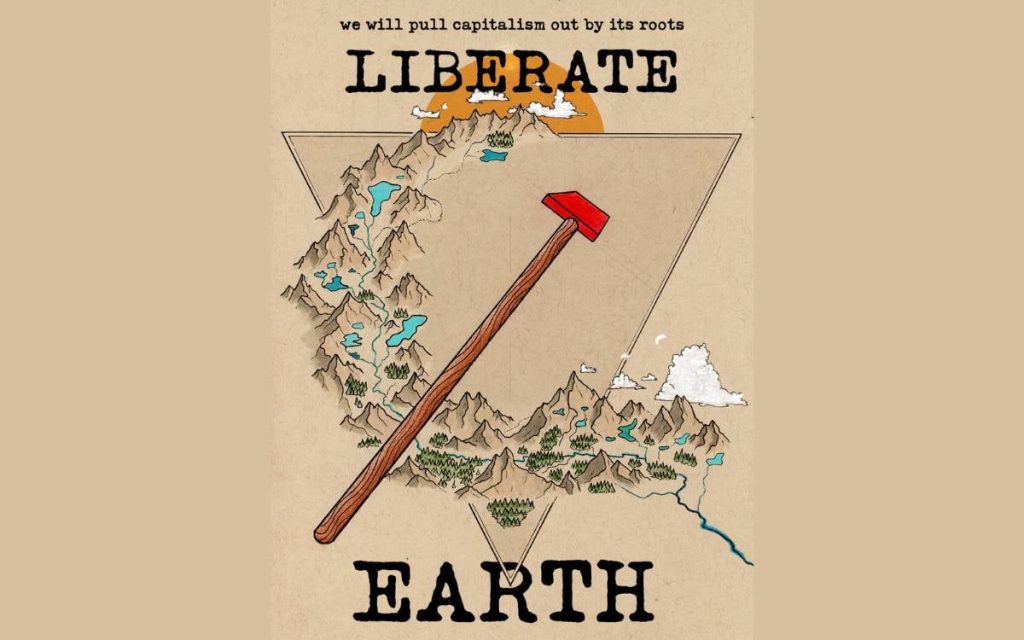
At a time when visual language is being homogenized and cheapened by artificial intelligence, and the bourgeois art market confines art to sterile galleries, the streets, campuses, and barricades continue to forge their own aesthetics of resistance. A product of this quest, Earth Liberation Studio rejects art as a market commodity, positioning it instead as an organizing tool for collective struggle and an object of political agitation.
Grounded in the premise that “as long as capitalism exists, the climate crisis cannot be solved,” the studio stands shoulder-to-shoulder with anti-colonial and anti-imperialist struggles from an ecosocialist perspective.
We spoke with its founder Link Berry, who describes himself as a “working-class art organizer,” about maintaining “revolutionary optimism” in the midst of the climate crisis, the mainstream movements’ blindness to the war industry and imperialism, the place of Palestinian resistance, and the agitprop aesthetics of the street.
At the core of Earth Liberation Studio lies a clear premise: As long as capitalism exists, the climate crisis cannot be solved, because the work required to restore the planet is inherently unprofitable under this system. What was your primary goal when establishing the studio with this mindset, explicitly as a political tool?
I knew I wanted to use art and political messaging as a way to process my despair, rage, and frustration about the climate crisis and the global political unwillingness to even address it. The art was a way for me to channel that emotion, and better establish what I thought solutions to the crisis might be. Making the art was a process of investigation and research into the subject matter which led me all over the place, brought me into various movements, introduced me to new friends and comrades, all of which led to the political conclusions held within the art.
My goal, in retrospect, was and is to help others like myself navigate the despair and rage they feel and direct their energy toward something, anything, that might move the needle in the direction of a better world. Or at least help them sleep at night. I don’t like to get grandiose about what art can achieve; I’m not sure it can create political change, but I think it can help people feel less alone, and in the best cases, encourage people to take action, find each other, and produce a line of questioning about the dominant cultural narratives.
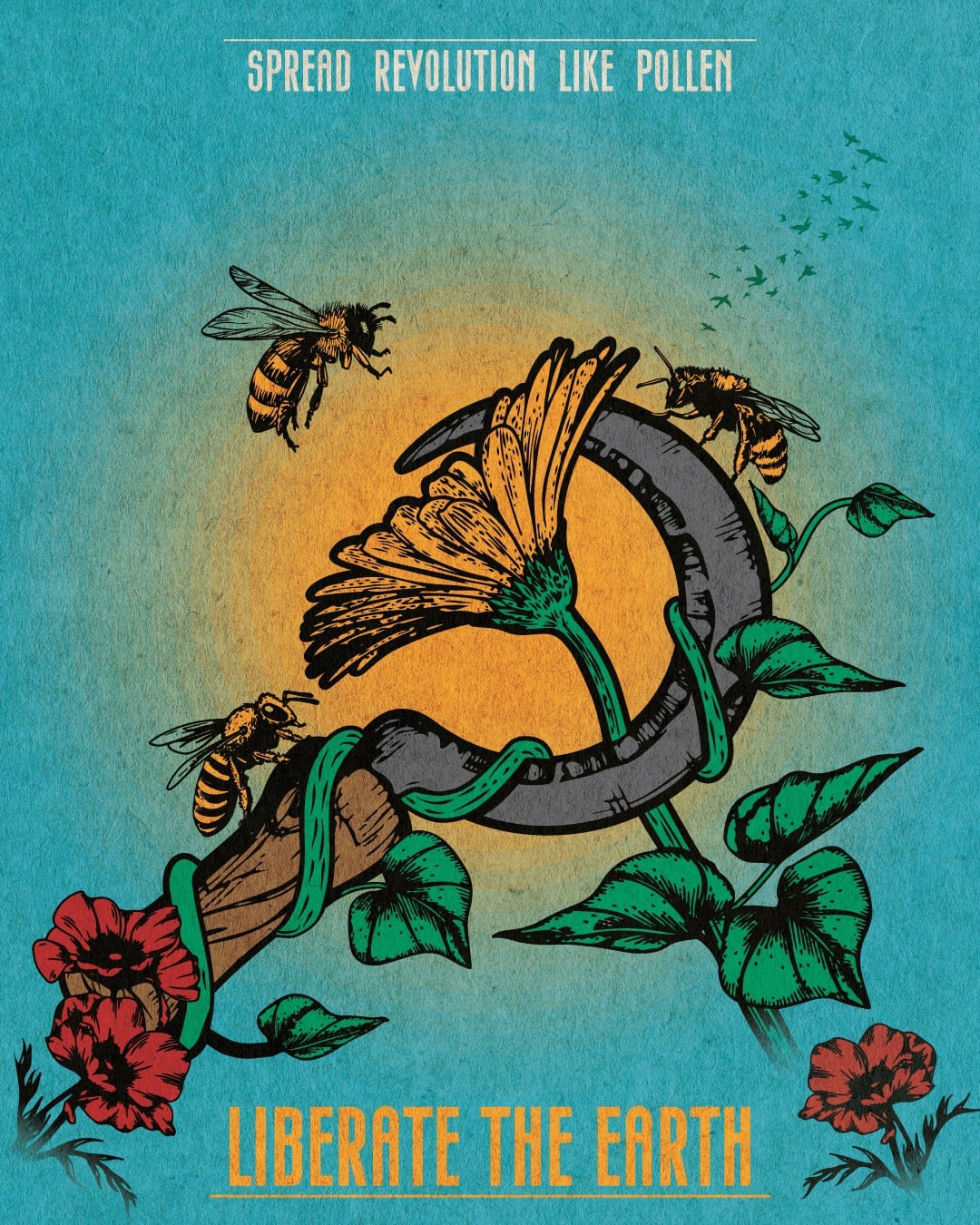
One of the foundational building blocks of your work is “revolutionary optimism.” Maintaining this optimism amidst climate collapse and global crises is no easy feat. What convinces you that we can break free from the shackles of capital, debt, and soul-crushing, alienating work? What separates this optimism from mere empty consolation?
It’s a foundational building block because it’s my biggest struggle.
Let me just start by saying that in order to create change we first have to believe it’s a possibility. If there’s no belief in possibility, that certainly shrinks our horizon of action considerably. What would 1917 have looked like if Lenin and the Bolsheviks had not truly believed revolution was possible? There were hundreds of their comrades insisting it was not possible, encouraging them to take less action, have a slow, incremental approach to gaining power. They seized Petrograd because they believed it was possible, maybe even in the face of evidence that it wasn’t.
Really the only thing convincing me that any better world is possible is the understanding that Anything could happen. We just witnessed the defeat and humiliation of history’s deadliest and most belligerent empire by the Iranians. In a world where the empire is so visibly crumbling, there are cracks everywhere. It’s hard to commit yourself to complete pessimism when the future is as unknowable as it has been this past decade. Openings are revealing themselves all around us, and if we don’t believe that we can fill those openings and start a revolution, then we won’t do it.
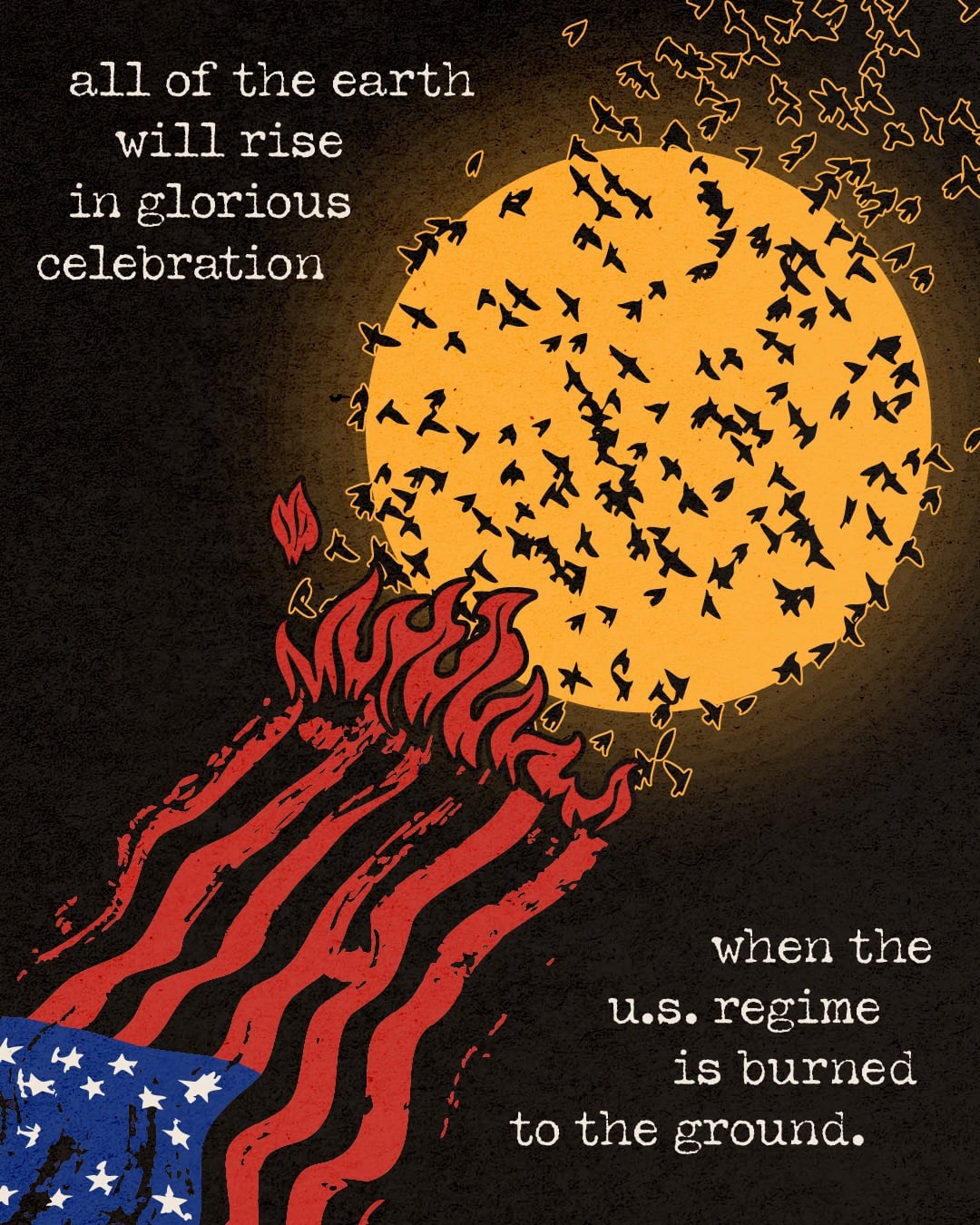
‘Artists propping up the dying empire are the real propagandists’
Your portfolio opens with Paul Robeson’s quote: “The artist must take sides. He must elect to fight for freedom or for slavery. I have made my choice. I had no alternative.” Today, the mainstream art world often dismisses explicitly political art as “propaganda,” declaring it aesthetically invalid, or confines it to sterile galleries. How do you think this agitprop aesthetic, which you create directly for the streets and protests, challenges the boundaries drawn by the art market?
As far as the dismissal by the mainstream art world of my work as ‘propaganda’, I say this: every accusation is a confession. The bourgeois art world holds up the status quo and peddles individualist, nihilist, and imperialist propaganda at us constantly. I call on all agitprop artists to reverse that accusation: they are, in fact, the propagandists, propping up the dying empire.
The bourgeois art world is woefully out of touch with the needs, desires, and tastes of regular working people. It’s often garish and nihilistic. A rag-tag group of agitprop artist comrades and I can (and have) put on an art show in an old thrift store and turn out more people than an opening weekend at some gallery in Beverly Hills.
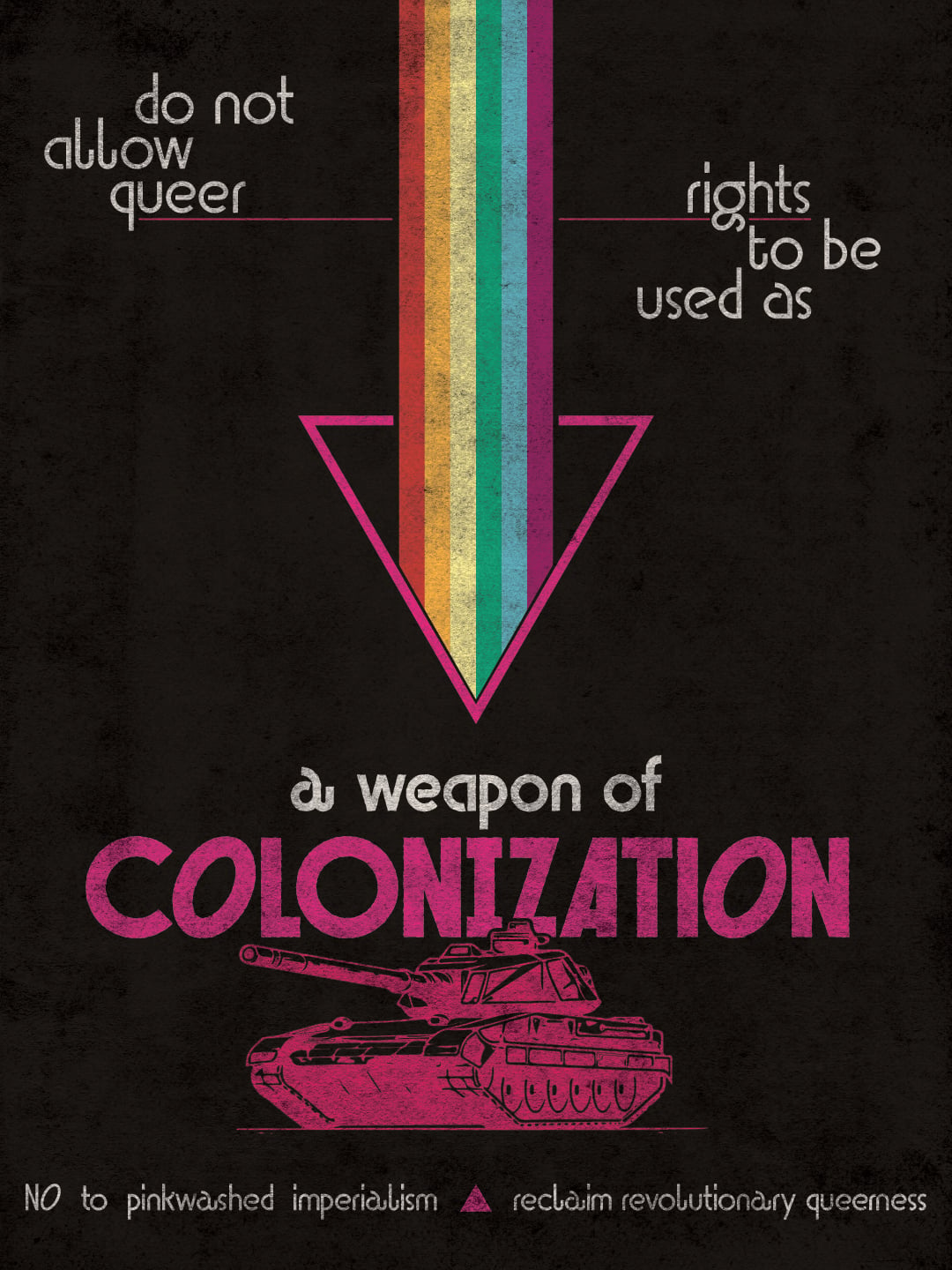
‘What I’ve gained in happiness, I’ve lost in economic security’
You define yourself as a full-time, working-class artist and art organizer. How does maintaining this radical and intense pace of production, while navigating the daily struggle for livelihood and the constraints of a day job, feed your perspective as a worker and shape your designs?
For most of my life, the need to have a ‘real job’ kept me from my need to make art. This is true of many artists, and we understand early on that capitalism diminishes us, keeps us from realizing our true selves, keeps us away from what we need to do. So, I internally understood the exploitative nature of capitalism, which helped form my politics quickly.
It’s been 3 years since I left my last ‘real job’, and the struggle is not much different – my time is still dominated by the need to produce commodities and get paid in order to pay my rent and survive. The commodities are however of my own choosing, which makes the work a lot more enjoyable. It was a worry, early on, that by leaving the workforce, I would be alienating myself from the struggle, and my work would grow increasingly out of touch. That hasn’t been the case; I’m making far less money as an artist than as a worker for an employer; so what I’ve gained in happiness, I’ve lost in economic security. It’s a trade I’d make in every lifetime, and it’s kept me from becoming unaware of the struggle.
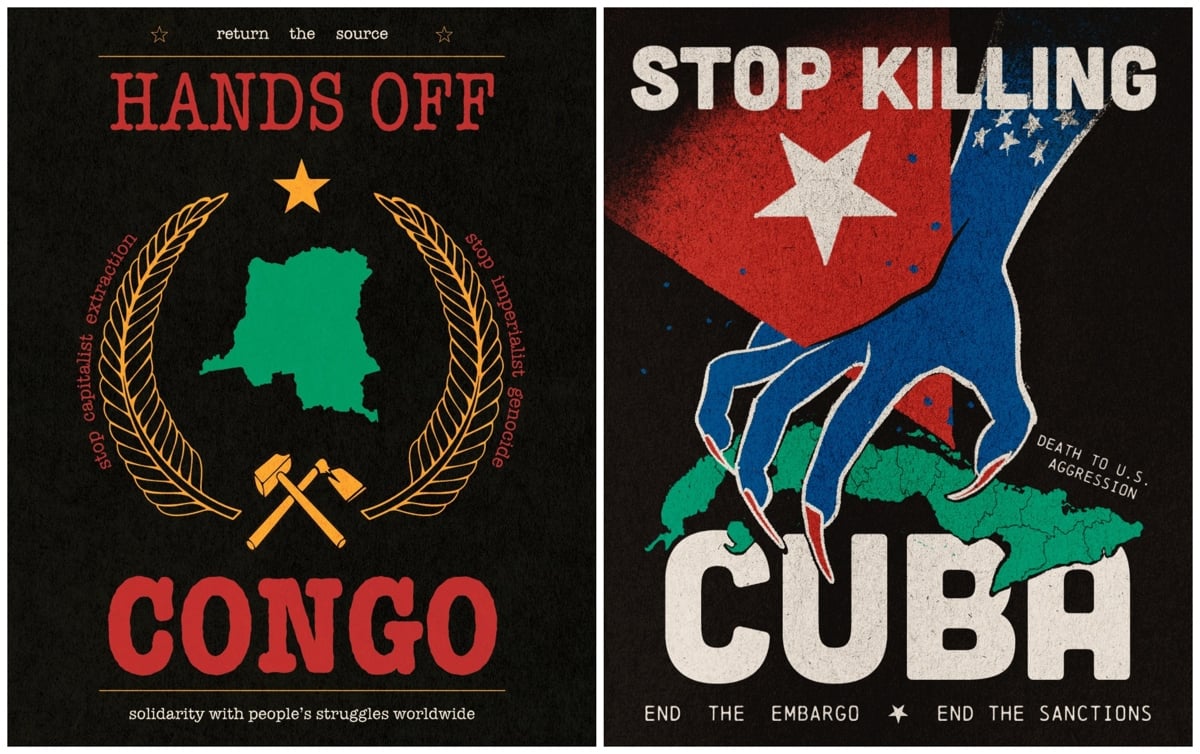
Throughout your descriptions, you explicitly note: “Absolutely no AI tools are used in the creative process of any piece, ever.” This is not just a technical explanation of your method; it is a profound principle. Given that data centers deepen the climate crisis through their massive energy consumption and that artists’ labor is being systematically exploited, where do you place this refusal within your own artistic ethics?
I find the environmental argument against AI and data centers a little toothless – yes, they are environmental disasters that are actively deepening the pit of disaster we’re all in, but that’s not necessarily different than, you know… everything else under capitalism. My resistance to AI therefore arises more from a respect and reverence for the creative process.
The generation of an idea, and the beginning stages of translating that idea into visual form is one of the most joyful experiences I’ve encountered in this life. It baffles me why anybody who has experienced that joy would want to outsource it to an algorithm, and it saddens me that new artists might not experience that joy because of the rise of generative AI.
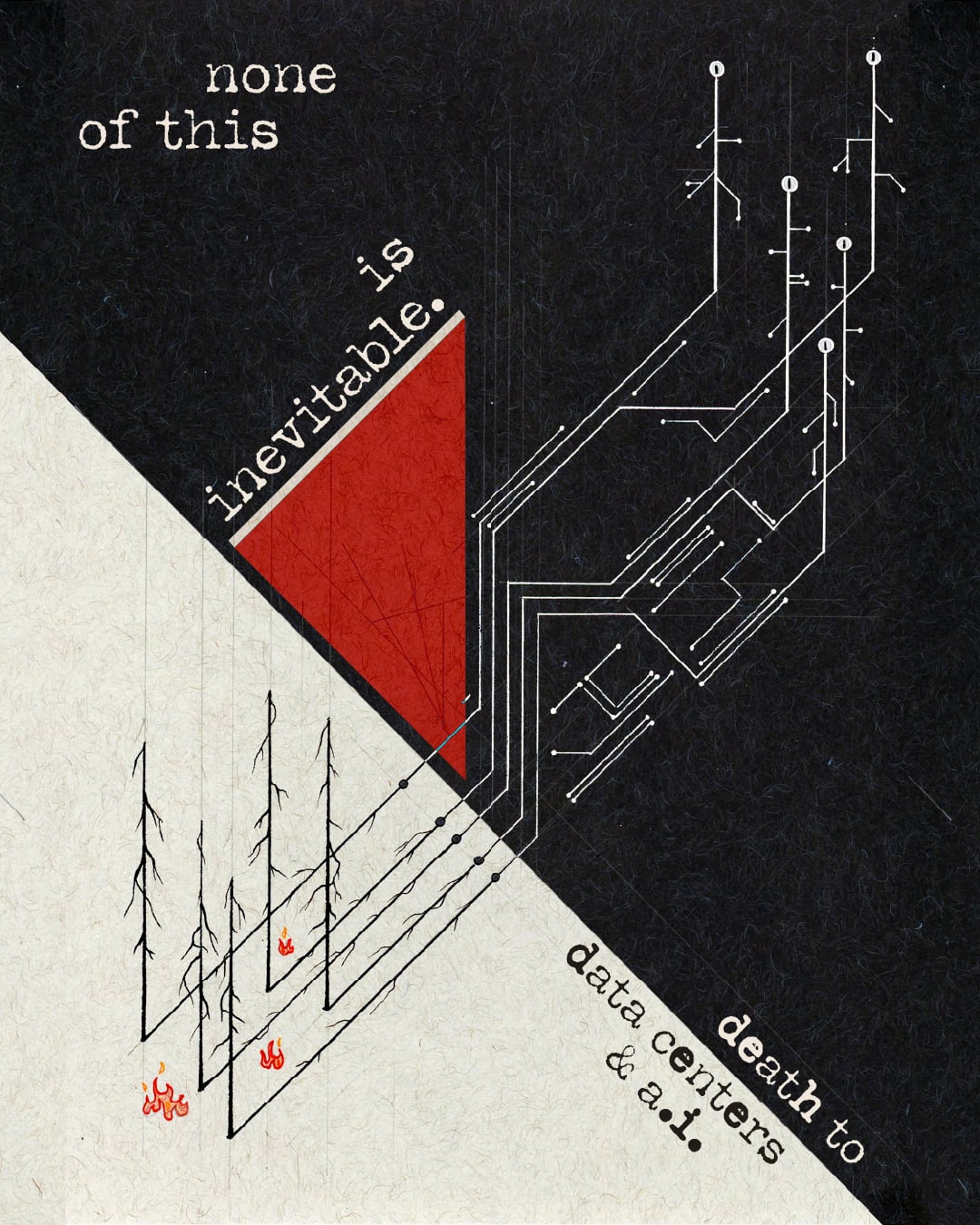
‘Imperialism is one of my most revisited topics’
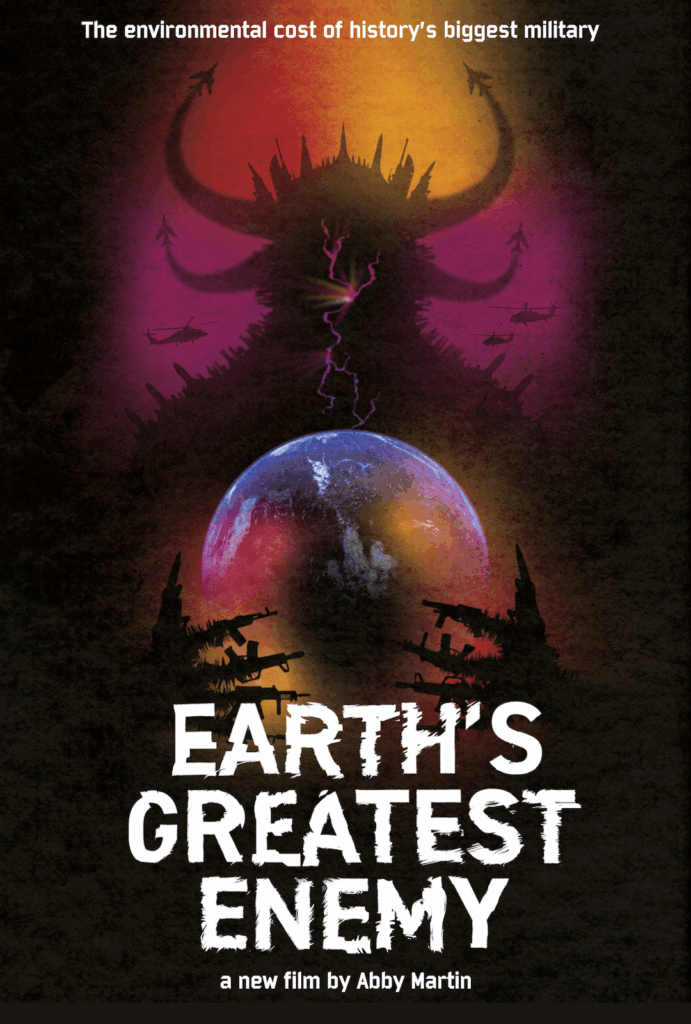
You designed posters for Abby Martin’s documentary “Earth’s Greatest Enemy,” which exposes the ecological devastation caused by the US military. While the military might of US imperialism secures global resource extraction, it also boasts one of the largest carbon footprints in the world. How do you strive to make this link between militarism and imperialism—which is so often ignored by mainstream climate movements—visible through your visual language?
There’s a common refrain within the western climate movement: they say that the US and imperialist bloc should be the force to ‘lead the world’ into a carbon neutral or carbon negative future. This of course views the US as a force for spreading democracy, or at least a neutral force, and one that ignores the imperialist and carbon intensive ways that the US has exploited the planet and put us in this mess. Sure, the US can lead – lead itself and other settler nations into the dustbin of history. Other than that, the US must be subjugated out of any sort of leadership role on the global front.
The more silent the mainstream movements, the louder the marginal movements have to be; so imperialism becomes one of my most revisited topics. Visual motifs such as military equipment – war planes, tanks, aircraft carriers, etc – are often portrayed being confronted, destroyed, eaten by forces of nature or groups of people and tools of sabotage.
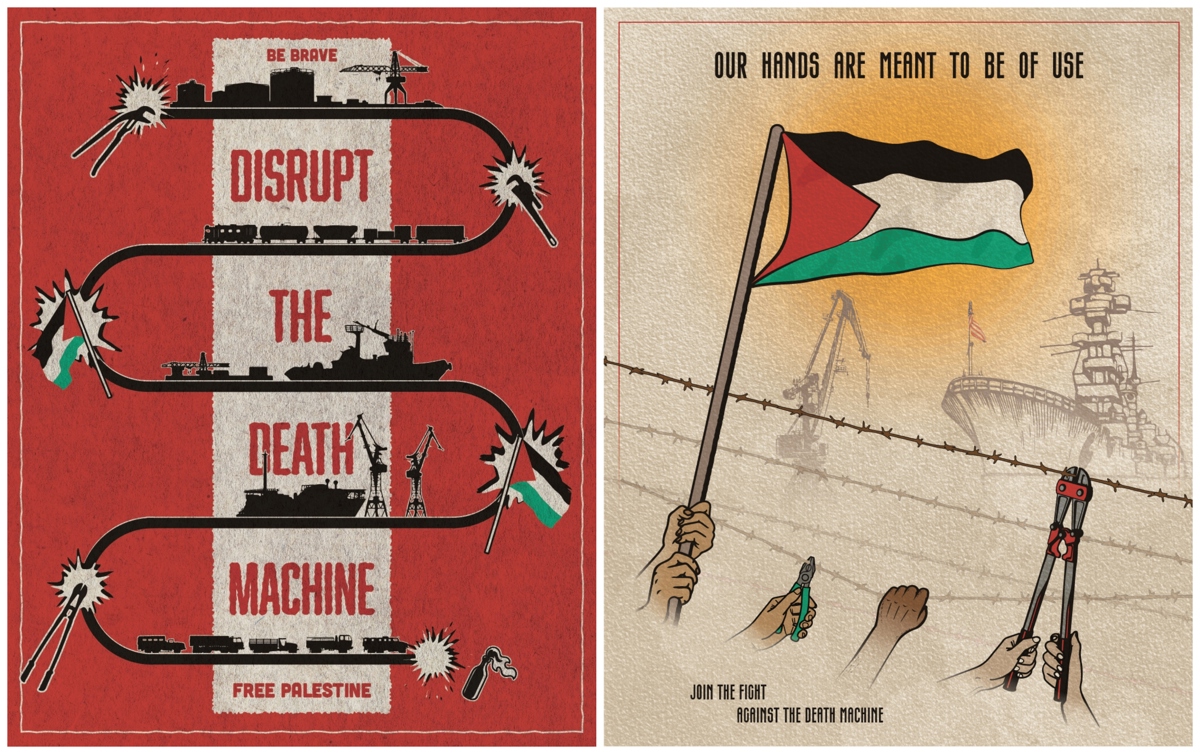
You have created works for activists blocking weapons shipments and students occupying campuses. In your manifesto, you state that anti-colonial struggles are key to solving climate change and creating a better world. Where exactly does the Palestinian people’s resistance against occupation and their anti-colonial stance fit into this narrative?
The struggle of the Palestinian people should be at the forefront of any serious environmental struggles. As seen across the planet, where native people thrive, so do the natural environments they care for. Decolonial struggles of all oppressed native populations ought to be celebrated, and the Palestinian struggle is among the most visible of these struggles, one that invites all of us into it as all of the western nations are implicit in the destruction of the Palestinians.
Relying on small contributions from ordinary people
We know that you have been involved in the climate movement for many years and define yourself as an “art organizer.” You position the studio completely outside the industrial and commercial art market. How does taking art out of the realm of gallery commodities and bringing it directly into collective struggle as an organizing tool liberate your creative process? How do you maintain the studio’s independent structure?
Being an ‘outsider’ in the bourgeois art world has certainly helped the studio get off the ground – not being beholden to the galleries or to the wealthy collectors, and instead relying on small contributions from ordinary working people, has been the only way to make this work possible. Every single person who purchases a print, shirt, or sticker, or subscribes on Patreon, or hires me for a commission, makes this work possible.
All of this work argues that a better world is possible. How do you tangibly envision that world—one where capitalism has been overcome, the planet begins to breathe anew, and humanity is liberated from the alienation of its own labor?
It’s admittedly hard to envision that better world as it probably lies on the other side of a great calamity that truly immiserates a massive portion of the world’s population, including those within the imperial cores. We see glimpses of that calamity and along with it, the possibility of a better world. When my city, Los Angeles, was hit by wildfires in 2025, we got a glimpse of what was possible. People rallied together to help each other, doing what they could to help. That’s the tangible way to envision the better world: the dissolution of isolating western lifestyles and the building of community.
You can also follow Earth Liberation Studio on X or Instagram.
(DS/VC/VK)
Source: BIANET