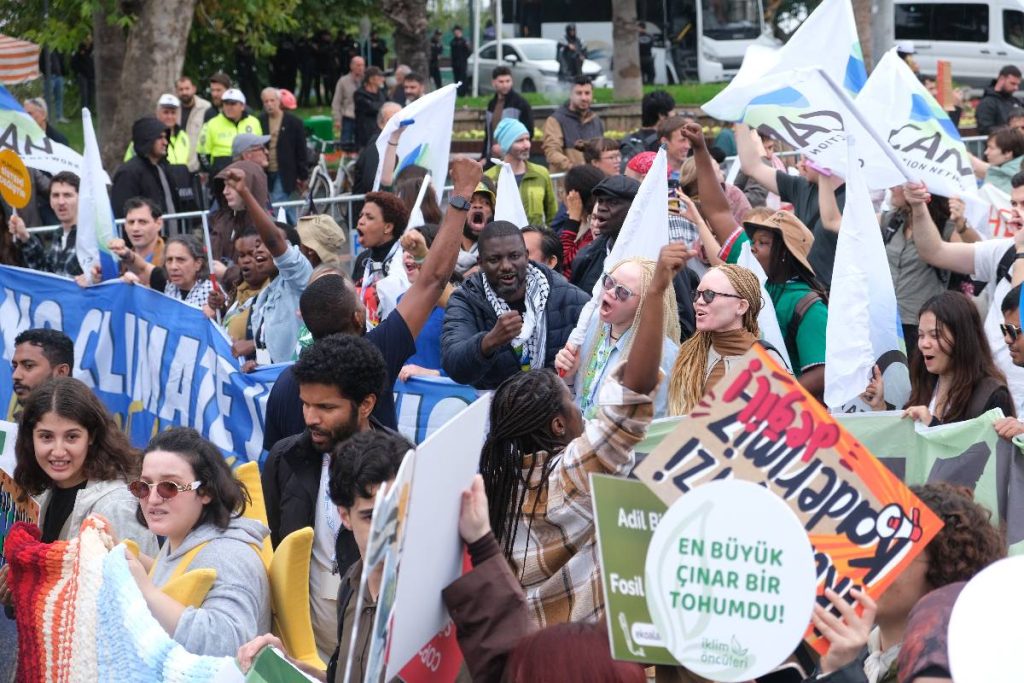
The Peoples’ Climate Summit (HİZ) opened in Antalya with a march bringing together participants from around the world ahead of events at the Mimar Sinan Congress Center.
The Global Day of Action march began at Aydın Kanza Park at 1 pm local time (GMT+3) on Nov 14.
According to summit organizers, approximately 5,000 people gathered at Cumhuriyet Square, with participants representing 80 countries.
During the march, bianet spoke with activists from different regions about climate justice, fossil fuels and the links between environmental struggles and broader social movements.
“First of all, I believe that the climate justice movement is, above all, a people’s movement,” said Marina Johnsons of the Wolf Clan from the Akwesasne Mohawk territory in what is now northern New York state.
I believe that climate justice begins, first and foremost, with the return of land. –Marina Johnsons
Yakutat Mukhtar, from Western Sahara, emphasized the importance of collective action.
“There can be no climate justice without the people. That is why we, as peoples, are taking action to demand justice right now, without waiting for tomorrow,” Mukhtar said.
We demand that member countries take immediate action. Every day we participate in COP, we need to remember why we are there. –Yakutat Mukhtar
Nilay Vardar of Beyond Fossil Fuels drew attention to the contrast between official negotiations and the experiences of communities affected by the climate crisis.
“On the one hand, decisions are being discussed in the Blue Zone at COP. Here, we have the people most affected by the climate crisis,” Vardar said.
We need to start reducing our emissions today. The easiest way to do that is to phase out coal. And that transition must be just. –Nilay Vardar
“There can be no climate justice without the liberation of Palestine”
Rachita Gupta, global coordinator of the Climate Justice Global Campaign, argued that climate justice could not be separated from struggles against war, colonialism and inequality.
“We are here because we say there can be no climate justice without the liberation of Palestine. We say there can be no climate justice until the wars and genocides in Sudan and Congo end. We say there can be no climate justice without Indigenous sovereignty,” Gupta told bianet.
She emphasized the need for cooperation among social movements addressing interconnected crises.
If we truly want climate justice, we believe that social movements and intersectional issues must come together. Because all these problems are taking place on one planet. –Rachita Gupta
Gupta linked the climate crisis to the economic structures she said were responsible for militarism, exploitation and declining social protections.
We know that the same corrupt, colonial and exploitative economic model that fuels wars and militarism, causes social protection crises around the world and drives this climate crisis. –Rachita Gupta
She also criticized corporations and wealthy individuals in the Global North.
“The same corporations and trillionaires in the Global North who plunder our lands, resources and bodies are also the ones profiting from this climate crisis,” she said.
They want to pump more fuel, more oil and gas into this planet simply to make a profit. There are trillionaires sitting in the Global North right now doing exactly that. –Rachita Gupta
Calls for fossil fuel phaseout and collective action
Throughout the march, participants called for climate justice, collective struggles among peoples, a transition away from fossil fuels, the phaseout of coal, concrete measures against plastic pollution and opposition to nuclear energy.
Following the march, organizers of the Peoples’ Climate Summit issued a statement outlining their demands.
To the Press and the People Around the World
We are suspicious. We do not trust them. And we demand a say in the decisions that affect our lives.
Governments Continue Their Hypocrisy!
The 31st Conference of the Parties to the United Nations Framework Convention on Climate Change (COP31) began in our city on 9 November and is still underway. And who is taking part? Predominantly government officials and representatives of fossil fuel corporations and other major companies. This tradition has remained unchanged for 31 years, and unfortunately, they have once again failed to surprise us.
The vast majority of countries participating in these summits have avoided putting concrete proposals capable of delivering genuine solutions to the climate crisis on their agendas. Nor have they made meaningful progress towards ensuring that the decisions adopted are legally binding.
Meanwhile, the cries of Pacific island nations, whose lands and living spaces face submersion in the very near future, have gone unanswered. The demands for justice from the peoples of countries that have contributed the least to the destruction of the planet have been met by major polluters attempting to buy their way out of responsibility through carbon markets.
Yet what people demand is not hush money or palliative measures dressed up in greenwashing, but genuine climate justice based on lasting and structural solutions.
Children, young people, farmers, workers, unemployed people, pensioners, care workers, refugees, women, and LGBTI+ people, who are among those most severely affected by the climate crisis, demand justice, not repression and exclusion.
And while the conduct of other fossil fuel-dependent states is plain to see, what are the COP31 hosts, Australia and Türkiye, doing in the face of these demands for justice?
Australia, one of the world’s largest coal producers, continues to invest heavily in fossil fuels. Türkiye, meanwhile, is paving over extensive agricultural land in Aksu to facilitate the transportation of international delegations arriving to discuss the climate crisis. It is spending billions of lira in public funds on cosmetic improvements to the city rather than addressing its structural problems.
While the government promotes its “Zero Waste” campaign, it is simultaneously turning the country into a dumping ground for Europe’s plastic waste. It also deliberately avoids making any commitment to phase out fossil fuels.
Like the COP31 hosts, Türkiye and Australia, all other capitalist states continue to display the same hypocrisy. While hosting climate summits, they simultaneously destroy and poison nature and all living beings through mining operations, hydroelectric dams, thermal and nuclear power plants, massive fossil fuel consumption, wars, and speciesist systems of domination and exploitation that deprive animals of their lives and freedom.
War Is a Crime Against Humanity and an Act of Ecocide!
For giant corporations and states concerned only with selling weapons, the lives of human beings, animals, and natural vegetation are of no importance. For them, the only thing that matters is money, money, and more money.
In the war between Russia and Ukraine, which has continued for years, tens of thousands of civilians and hundreds of thousands of soldiers have been killed or wounded.
More than 3,000 people were killed in the war between the United States and Iran, including at least 254 children.
Since 7 October 2023, Israel’s actions in the Gaza Strip have included the deliberate deprivation of food, measures intended to prevent births, the destruction of civilian infrastructure, the bombing of healthcare facilities, the killing of healthcare workers and humanitarian volunteers, attacks on journalists, large-scale forced displacement, sexual violence, and the destruction of cultural sites and educational institutions.
These actions have resulted in more than 70,000 deaths and approximately 170,000 injuries in Gaza.
The devastation caused by this overwhelmingly one-sided war has left a stain of shame on the conscience of humanity and of every country in the world.
Beyond this mass slaughter and the crime of genocide, the ecological destruction caused by wars is also rarely addressed at COP summits.
Access to Just and Healthy Food and Clean Water Is Everyone’s Right!
The capitalist system not only drives ecocide by disregarding the finite resources of our planet, but also poisons the water, air, soil, and food on which all living beings depend through conventional agriculture characterised by the intensive use of pesticides. It is destroying biodiversity at an astonishing rate.
Healthy and fairly produced food is available only through relatively small-scale production by a limited number of producers, while poorer communities are unable to access it.
As a result of enormous global income inequalities, billions of people cannot even meet their basic nutritional needs, let alone access food produced in socially and ecologically just ways.
Access to healthy food and clean drinking water is a fundamental right of every living being, and this right must be guaranteed.
Yet no state operating within a capitalist system driven by the imperative to “grow or die” is willing to create the conditions necessary to secure these rights.
Agroecological agriculture has the potential to feed the world while protecting the planet. What is needed is the political will to make it happen and a just distribution of resources!
The Climate Crisis Is a Class Issue!
Because although we all live under the same atmosphere, we do not share the same economic and social conditions.
While a company owner can escape extreme heat by retreating into an air-conditioned office, construction and road workers are forced to labour under the scorching sun.
While large agribusiness corporations can shift the costs of drought onto other areas of their operations, small farmers may lose their very livelihoods when their crops fail.
While the wealthy can escape flooding by moving into another property, a worker living in a poor neighbourhood may have no choice but to remain at home and await the disaster.
The solution to the climate crisis lies in the democratic planning of production and resources.
The issue is not simply replacing fossil capital with green capital. The fundamental questions are: For whom are energy systems being transformed? Who controls this transformation? And whose interests does it serve?
Our demand for climate justice challenges a model of transition in which the costs are imposed on workers and ordinary people while the profits are captured by capital.
Our Call to All Defenders of Life Across the World
From Glasgow to Dubai, from Belém to local struggles across every corner of the world, climate justice movements have been proclaiming the same truth for years:
Climate justice will not be granted by capital. It will be won through the struggles of the peoples!
(CA)
Source: BIANET