Protecting the storytellers: Women journalists on the frontline of conflict
“Every woman journalist driven out of a conflict zone is a peace process that loses its witness,” said Nobel Peace Prize laureate Maria Ressa, addressing the United Nations this week.
She urged governments to move beyond promises and take concrete action to protect women media workers in the field.
“When the messenger is a woman, it is sexualized, it’s dehumanizing, and it is relentless,” said Ms. Ressa, co-founder of the Philippine news organisation Rappler.
As part of Women, Peace and Security Week, she was speaking at a high-level event organised by the Permanent Mission of Greece, gender equality agency UN Women, and the UN education and culture agency, UNESCO, which champions journalist protection.
‘Fight before it’s too late’
Ms. Ressa, who has faced arrest, legal cases and sustained online attacks, reiterated how intimidation can wear down journalists’ credibility and confidence, threaten their safety and ultimately kill their determination to continue reporting.
At the height of the attacks against her, she received 90 hate messages an hour.
The attacks illustrate how gender-based abuse can be used to discredit women who challenge those in power.
“Kill the messenger to kill the message,” she explained to the event – Every Voice for Peace Counts: New Perspectives on the Women, Peace and Security Agenda.
AI enabler
Artificial intelligence is adding to the threat, enabling deepfakes, fabricated sexual images, cloned voices and coordinated attacks to spread at scale.
According to UN Women data, nearly one in four women human rights defenders, activists and journalists reported experiencing AI-enabled abuse which in time can manifest as physical violence.
Recent research highlights how online attacks – once dismissed as “virtual” problems – are now spilling offline, affecting women’s safety, well-being, and ability to participate freely in public debate.
Ms. Ressa called for online violence to be treated as such, arguing for stronger accountability for perpetrators and technology companies that amplify abuse, sustained funding for women-led journalism, and the inclusion of women journalists in peace and security discussions.
‘This is the moment’
Invoking the words of Mzia Amaglobeli, a Georgian journalist who remains imprisoned, Ms. Ressa described how she had held up a copy of How to Stand Up to a Dictator in court when she was unable to speak freely.
“What she said from her cell is, fight before it’s too late,” Ms. Ressa said. “We’re getting there. This is it. This is the moment.”
She called on journalists, civil society, governments and international institutions to stand together against a system that allows attacks on women journalists to go unchecked.
“We refuse to be the victim,” she said. “The women here turned the attack into the story, and every time one of us stood up, others stood with us. Courage is contagious. But courage isn’t a protection strategy – the nations of the UN are”.
The meeting took place 26 years since the adoption of Security Council resolution 1325, which affirmed the importance of women’s full participation in conflict prevention, resolution and peacebuilding.
Keeping Afghan women’s voices alive
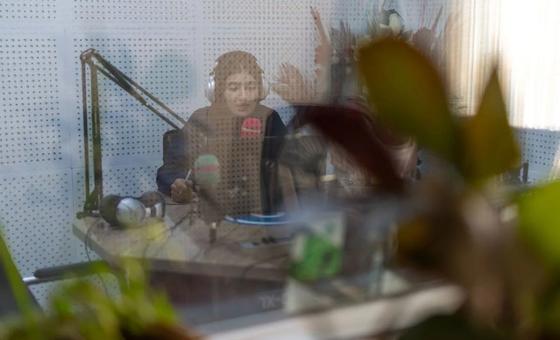
For Afghan journalist and media entrepreneur Hamida Aman, protecting women journalists means ensuring that millions of women are not shut out of public life altogether.
When she launched Radio Begum in March 2021, her aim was to create a space where Afghan women could share their experiences and access information relevant to their lives. Since the Taliban takeover, restrictions have made that work increasingly difficult.
Citing figures from the International Federation of Journalists, Ms. Aman said the number of women journalists in Afghanistan had fallen from about 2,800 before the takeover to fewer than 700.
“Being allowed to operate doesn’t mean being free to operate,” she said, describing the scrutiny and administrative obstacles facing Radio Begum. The organisation has been threatened and temporarily shut down, and some colleagues have been jailed for more than six months.
“If these journalists disappear, who will speak about the lives of Afghan women? Who will make their voices heard?” Ms. Aman asked.
Silencing collective stories
Protecting women journalists is not only about individual safety. It is also about whose experiences of conflict are documented, whose voices shape public understanding and whose contributions to peace are recognised.
“When women journalists are silenced, the women whose stories they are telling is also silenced,” said UN Women Deputy Executive Director for Normative Support, UN System Coordination, and Programme Results, Nyaradzai Gumbonzvanda. “So, it’s not just the silencing of the journalists, it’s the silencing of our collective story.”
Women in conflict settings are often portrayed as victims, she noted, despite their roles in preventing violence, mediating disputes, sustaining communities and rebuilding societies. When their experiences go unreported, the public sees only part of the reality of war, “half of the picture of peace”.
The scale of the problem is stark. According to a recent study by UN Women and UNESCO, 75 per cent of women journalists surveyed had experienced online violence. Forty-two per cent linked online attacks to abuse or assault in the physical world, up from 20 per cent in 2020.
Meanwhile, between 2013 and 2023, coverage of conflicts grew more than sixfold, yet only 5 per cent of published articles focused on women’s experiences of war. Just 0.04 per cent mentioned women leaders in peace processes, according to figures presented at the event. “We are not invisible”, Ms. Ressa told the room of women in New York.
Begoñã Lasagabaster, Director of UNESCO’s Division for Gender Equality, recalled the exhibition They Told the World About It, documenting almost 200 women journalists from more than 25 countries who reported on the Spanish Civil War 90 years ago.
“While much of the world counted battles, these women counted lives – they wrote about hunger, displacement, about what war does to a mother, a father, a child, a city, a country,” she said, and with that “they changed the way the world saw war”.
Protection must become action
International frameworks for protecting journalists already exist. Yet women journalists continue to face physical violence, legal harassment, psychological trauma and online campaigns designed to discredit their reporting.
As the International Day to End Impunity for Crimes against Journalists approaches on 2 November, UNESCO is preparing to launch a new campaign – Threats Evolve, Impunity Endures – alongside new findings on journalist safety and impunity.
“Every voice for peace counts,” said Ms. Ressa, “but a voice only counts if it is heard, if that woman survives being heard.”
Watch the event on UN WebTV:
Source: UN News