
The Rojava Solidarity Committee in Portugal released a statement marking the 13th anniversary of the Rojava Revolution.
Saluting 13 years of struggle and a new way of building society, the Committee highlighted the importance of international solidarity with North-East Syria amid the new threats it faces today, mainly from the self-proclaimed transitional government led by Ahmed al-Sharaa.
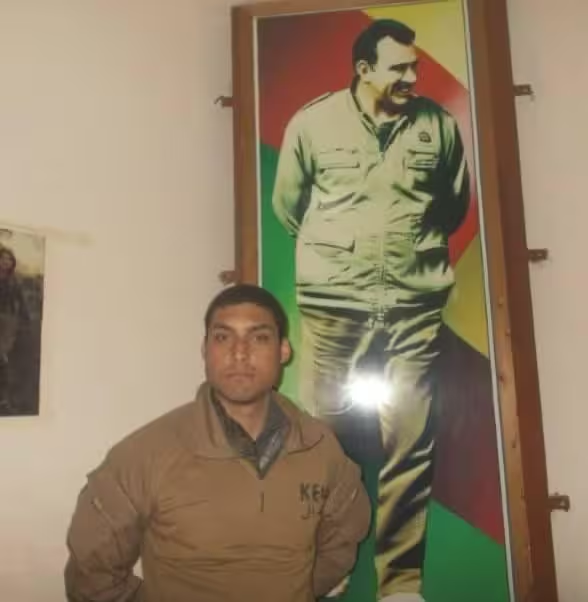
The Rojava Solidarity Committee also paid tribute to internationalist activist Mário Nunes, who joined the struggle against ISIS in Rojava in early 2015 and lost his life in Til Temir in May, 2016. Before his death, the YPG volunteer Mario Nunes said: “I am here to fight with the people of Rojava on behalf of the Portuguese people. This is a cause worth fighting for. A new movement is arising here. This is true democracy. This is a revolution that everyone should support and praise.”
The Rojava Solidarity Committee statement reads as follows:
“July 19 marks 13 years since the start of a revolutionary and liberatory process known as “The Rojava Revolution”. In 2012, the north and east of Syria faced the beginning of a civil war that had spread to practically the entire territory of the country. Amid a conflict between various oppressive forces with authoritarian, jihadist and patriarchal views, a third way emerged on July 19. With the Kurdish people at the forefront of a multi-ethnic, feminist and interfaith project, it showed the world the strength and example of this path to freedom.
In this region, better known as Rojava, the ideas of democratic confederalism, developed by Abdullah Öcalan, gave impetus to a new way of building society – from the bottom up, based on popular assemblies – focusing on the emancipation of women, coexistence and mutual respect between different ethnicities and religions and the ecological issue. This process also distinguished itself from others in the region by not seeking the formation of a state of its own, recognizing that the formation of a Kurdish state would not solve the problems that could only be solved by a profound social transformation.
After the fall of the Assad regime in December 2024, the DAANES (Democratic Autonomous Administration of North-East Syria) is facing a new reality – although one of its enemies has fallen, another has taken power: the HTS and its leader Al-Jolani, or Mohammed Al-Sharaa, whose links to Al-Qaeda and ISIS are undeniable. The influence and power that Turkey has over this new regime is also undeniable, as are Qatar and the US…
After 13 years of revolution, Syria is facing a new challenge with a new authoritarian regime. In March of this year, the Alawite people on the country’s coast suffered a series of massacres at the hands of the new regime. This week it was the turn of the Druze people in the south of the country. The diversity of cultures and peoples is under threat from this new regime. The new regime’s mentality of occupation, genocide and racism is the same as that which threatens the Kurdish people in the four occupied parts of Kurdistan, the same as that which the Palestinian people experience in Palestine, the same as that which the Baluchi people suffer in their occupied territory, the Sahrawi people, the different peoples of Myanmar and so many others.
That’s why today we celebrate the Rojava revolution and the anti-fascist and democratic feminist project of the Kurdish Freedom Movement. That’s why, today, it’s so important to show our solidarity, however symbolic it may be, with this alternative that is being proposed and put into practice, not just for the Kurdish people but for all the peoples who are looking for an alternative to the wars of states, genocide, assimilation and occupation policies, patriarchy and fascism.
In the words of Mário Nunes, Sehid Kendal Qaraman, the Portuguese martyr who died fighting the fascism of the Islamic State, “One people, one world”. Our solidarity is international and with all peoples!
Mário Nunes (Nom de Guerre: Kendal Qahraman) was from the south of Portugal originally. In 2015, he deserted from the army of Portugal after following up on what Daesh was doing and with the will to go and help the fight. He joined the 223 unit in Rojava, a special unit of internationalists fighting ISIS in the YPG. He participated in the operation to liberate Shadadi town among others. On the 3rd of May 2016, he fell a martyr in Tel Tamir.”
Source: ANF News