
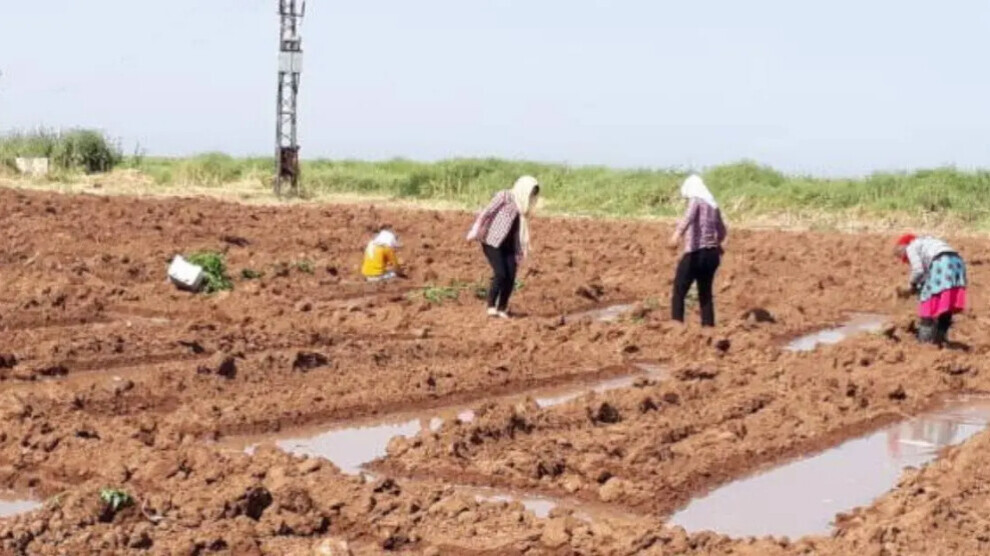
The Rojava Revolution, which began in Kobanê on 19 July 2012 and later spread across all of Northern and Eastern Syria, is now in its thirteenth year and continues to draw attention with its economic model based on democratic confederalism and the principles of an ecological society.
This system, grounded in local self-governance, organized through cooperatives, and aiming for harmony with nature, seeks to meet the needs of the local population and strengthen social solidarity, despite challenges such as war, embargo, and instability.
In this report, we examine the region’s economic structure, cooperative experiences, current challenges, and future goals through interviews with Leyla Sarokhan and Mohammed Sabri, Co-Chairs of the Economy and Agriculture Council of Northern and Eastern Syria; Jivan Shikri, Co-Chair of the Cooperatives Committee; and Farhad Dede, spokesperson for the Star Salt Cooperative.
Although we aimed to directly observe other cooperative experiences and hear from their representatives, we were unable to obtain the necessary permissions. For this reason, our report is limited to the experience of the Star Salt Cooperative.
Foundations of the democratic economy model
Leyla Sarokhan, Co-Chair of the Economy and Agriculture Council of Northern and Eastern Syria, explains the region’s efforts to build a democratic economy and the critical role women have played in this process. Despite the conditions of war and embargo, the council seeks to meet social needs through local assemblies, aiming to achieve economic stability through cooperatives and an egalitarian approach.
What are the founding purpose and main duties of the Economy and Agriculture Council of Northern and Eastern Syria? How does the decision-making process function within the council?
The Economy and Agriculture Council of Northern and Eastern Syria works in coordination with the established canton assemblies. Above all, our goal is to build a democratic economic system together with these assemblies. Through this democratic system, we aim to include all segments of society in economic work and ensure that everyone can be economically self-governing. On this basis, we strive to meet all the needs of society.
These assemblies were formed through democratic elections. All economic issues are discussed within the council, along with proposals from different regions, and decisions are made here. Initially, each canton holds its own internal discussions, what are the needs and problems, and what proposals can be offered to overcome them?
These views and proposals are then brought to the meetings of the Economy and Agriculture Council of Northern and Eastern Syria, with the participation of representatives from all cantons. Comprehensive discussions are held in these meetings. The agricultural capabilities, as well as the cultural perspectives and differences of each canton, are taken into account. Discussions proceed on this basis, and decisions are made collectively with the participation of all council members.
The role of women in the economy and the challenges faced
Women play a significant role in your cooperatives. What role do women have in your current economic system? What steps are you taking to enhance women’s participation, and what challenges are you encountering in this area?
According to the Social Contract, there must be equal gender representation within both the autonomous administration and all our institutions, including the Economy Council. However, in some institutions, women’s participation exceeds fifty percent, while in others it falls below. We are making efforts to ensure equal representation of women and men in every institution.
Ensuring women’s participation in our economic institutions is a primary goal. Our councils have been structured on this basis. We operate under a co-chair system, and we are striving to maintain a gender balance within both our councils and institutions.
We are also working to strengthen women’s participation and representation within our cooperatives and economic initiatives. Just as we have general cooperatives, we also have special cooperatives run entirely by women. The members of these cooperatives are all women, and they manage their cooperatives independently.
From the beginning of the work, through the production phase, and even to the marketing of products, all stages are handled by women. On this basis, we are working to increase the number of women involved in cooperatives.
However, there are serious challenges rooted in the dominant ideas shaped by the previous system and the global dominance of the capitalist order and its impact on society. People tend to focus on maximizing profit. Particularly in our region, we have been living under war and embargo for years, which has negatively affected society’s economic development.
As a result, while people do want to participate in economic activities, the dominant mindset and prevailing economic difficulties have led many to focus only on financial gain. Yet the system we are trying to develop does not solely aim for profit or product output. Rather, we envision an economy rooted in ecology and labor.
We have faced many difficulties due to these dominant mentalities. Looking back to 2016 and 2017, when we began to establish cooperatives, many people assumed we were building cooperatives similar to those formed under the previous regime. They thought of it as a stock market model: “I will invest my money and receive profits at the end of the year.”
Because of this, some cooperatives succeeded, while others failed to meet expectations; many shortcomings emerged. We came to the conclusion that in order to successfully build cooperatives based on a democratic society economy, we first had to correct the prevailing understanding. Only then could the cooperative system succeed. This applies to society as a whole.
Women, in particular, face more obstacles because they often do not have access to the working conditions they need. Due to the influence of this mindset, we encounter difficulties in ensuring women’s participation. However, significant steps have been taken. Women’s cooperatives have been established, and women are leading them.
Through both our insistence and the determined participation of the women involved in these cooperatives, this work continues. The aim is to further increase both the number of women and the number of women-led cooperatives.
The impact of war and embargo on the economy
How have the years-long war in Syria, the political instability under the Damascus administration led by Jolani, who replaced the Ba’ath regime and the ongoing attacks and occupation by Turkey affected your economic activities? What kinds of measures are you taking to maintain economic stability under such conditions?
Undoubtedly, the ongoing state of war over the years has severely impacted the regional economy. Turkey’s obstruction of the Euphrates River flow has affected both energy production and agricultural lands. At the same time, the war against the Islamic State (ISIS) significantly damaged our economy. As a result of the conflict, many wheat silos were rendered unusable.
These conditions have created serious difficulties. Even in years with sufficient rainfall, we are forced to store wheat outdoors due to a lack of proper storage facilities. Many irrigation canals have been destroyed and are no longer functional. Large areas of land suitable for irrigated farming used to rely on water from the Euphrates, but when the canals became unusable, we were pushed toward dry farming. However, it is not possible to establish a stable, strategic agricultural system based solely on dry farming. The rainfall required for dry agriculture varies each year and does not consistently yield adequate crops.
In addition, the Turkish state’s attacks on infrastructure, especially oil wells, have caused significant damage to the economy. This is because the irrigated agriculture model we are working to develop largely depends on these wells and the diesel fuel produced from them. These attacks have had a substantial impact on agricultural productivity.
I emphasize agriculture in particular because 60 to 70 percent of our economy is based on agriculture. When oil wells are attacked and rainfall is also insufficient, crop yields are significantly reduced. Moreover, the siege imposed on the region creates major obstacles in acquiring necessary raw materials and exporting surplus products. Since we do not have official international recognition, it becomes very difficult to bring in essential goods and to export what we produce.
For example, the cotton yield in 2023 was quite strong. The Autonomous Administration purchased the cotton from producers at a fair price, which brought great joy to the farmers. However, in the end, we were unable to sell the cotton abroad because our region is under embargo. As a result, the Autonomous Administration suffered a major loss. In general, the current conditions have created a state of economic instability in our region.
Therefore, we have built our primary strategy around economic self-sufficiency. We are focusing on creating a system in which we can meet our own economic needs within our own territories.
Participation of ethnic and religious groups
How do you ensure the equal participation of different ethnic and religious groups in economic processes? What challenges have you encountered in this regard?
This is honestly the area where we feel most comfortable and where we have achieved the greatest success. Years of work have brought us to a point where we have been able to eliminate authoritarian and chauvinistic mindsets from among us. Our entire system is built on the principle of brotherhood among peoples. This is also true in the economic field. Arabs, Kurds, Assyrians, Turkmens, we all work together, side by side. Both in the social sphere and within our councils, representatives of all communities are included.
Future vision and sustainability
How do you evaluate the sustainability of your economic model in the long term? What are your goals for the future?
In the future, we want to establish our system on stronger foundations and further develop our cooperative model. Our goal is to ensure that the economy truly belongs to the people of this society. Around the world, there are many examples of cooperatives that have been run for years. However, in most cases, people participate in these cooperatives with the capital they possess. Some contribute with their labor, while those who contribute capital often do not work but earn more, whereas those who work hard earn far less than the value of their labor. We do not want our cooperatives to function in this way. Our cooperatives are built on labor. We want to further develop this system so that we can organize our economy through cooperatives and meet the needs of society.
Priorities for economic development
What are your priorities for the region’s economic development? Which areas do you plan to focus on over the next five to ten years?
Agricultural production forms the foundation of our economy. Our land and climate are highly suitable for farming. For this reason, our entire economic policy is built around agriculture. In the past, the policies imposed on our regions were focused on strategic crops, and these crops were treated solely as raw materials. In the coming years, we aim to develop factories that can process the agricultural products we cultivate. In other words, we do not want the crops we grow to remain as basic raw materials. We want to develop our industry so that we can process these products and return them to society in a more valuable form.
A call to society to join cooperatives
Lastly, do you have a message or a call for society regarding greater participation in cooperatives?
No one who wishes to be free can truly achieve freedom unless they also attain economic freedom. The most suitable system in which people can live freely, especially in economic terms, is the cooperative system. In our model, as a cooperative becomes more successful, it becomes the property of society. Every member who takes part in a cooperative gains a sense of ownership in their work. A person who is not the owner of their own labor will always remain in a position of oppression.
Strategic goals of the social economy
Mohammed Sabri, Co-Chair of the Economy and Agriculture Council of Northern and Eastern Syria, outlines the region’s economic strategies and the social economy model established under the Autonomous Administration. He speaks about the diversity of regional facilities, the development of agriculture and animal husbandry, and the measures taken despite the ongoing conditions of war.
Duties of the council and decision-making process
What is the primary duty of the Economy and Agriculture Council of Northern and Eastern Syria? How does the decision-making process function? How are the canton assemblies involved in decision-making? What was the purpose behind establishing this council?
With the formation of the national council, the Social Contract for Northern and Eastern Syria was ratified, and on that basis, the Economy and Agriculture Council of Northern and Eastern Syria was established on 7 October. The main purpose of this council is to eliminate bureaucracy and guarantee the decision-making power of the cantons.
The core role of the Economy and Agriculture Council of Northern and Eastern Syria is to determine the economic strategy of the Autonomous Administration, and related decisions are made by the regional economy and agriculture councils. At the same time, the aim is to promote more rapid development through the organization of these councils and to advance the economic development of Northern and Eastern Syria.
Work facilities across the region
Approximately how many work facilities exist in Northern and Eastern Syria? What types of operations are these facilities mostly engaged in?
Across Northern and Eastern Syria, there are many work facilities, both large and small. Some of these are privately run by members of the community, while others operate under the Autonomous Administration or the Economy Council. There are around two thousand facilities in total, employing thousands of people. These facilities, with their autonomous structures, meet many of the region’s needs in both the agricultural and industrial sectors.
For example, the poultry sector is strong enough to meet the region’s demands. In addition to dairy and cheese products, items such as plastic bags, livestock products, wheat, chickpeas, beans, and bulgur produced in these facilities serve to meet the essential needs of Northern and Eastern Syria.
Development of agriculture, livestock, and small-scale trades
What new methods are you pursuing for the development of livestock, agriculture, and small-scale trades? What is the current level of progress in organic and ecological farming?
As the Economy and Agriculture Council of Northern and Eastern Syria, we are supporting the development of livestock production. In particular, we provide assistance related to animal feed and similar needs. We are also offering significant support to poultry farms.
For the development of small-scale trades, a social market is being developed across Northern and Eastern Syria. A special committee has been formed for this purpose. The committee’s primary goal is to resolve issues between producers and consumers, enabling producers to deliver their products directly to consumers without relying on middlemen or traders. In addition, this committee aims to prevent traders from arbitrarily setting product prices by providing support to small-scale vendors across the region.
The impact of war and attacks on the economy
How have the years-long war in Syria, the political instability under the Damascus regime now led by Jolani after the Ba’ath regime, and Turkey’s ongoing attacks and occupation affected your economic activities? What kind of measures are you taking to maintain economic stability under these conditions?
The occupying Turkish state’s attacks on Northern and Eastern Syria, as well as the destruction of critical infrastructure, have had a direct and significant impact on the region’s economy. Despite these attacks, the peoples of Northern and Eastern Syria have demonstrated a determined stance and have managed to develop measures to cope with the problems caused by the Turkish state’s bombardments.
One of the most difficult challenges we have faced was the inability to meet basic needs due to the bombing of wheat silos and water stations. In spite of all the attacks, the people, through their unity and resistance, continue to overcome the crises caused by the occupying Turkish state.
Future economic plans
What are your priorities for the region’s economic development? Which areas do you plan to focus on over the next five to ten years?
Looking ahead, we aim to build a social economic system through projects and organizational structures based on communes, councils, academies, and cooperatives. In Northern and Eastern Syria, we base our approach on the principles of a social economy, and a specific budget has been allocated for this purpose. The goal is to reduce unemployment, address the ongoing economic crisis in the region, and support the development of both the agricultural and industrial sectors. Support for the agricultural sector involves securing the necessary seeds. In addition, we aim to promote organic fertilizers and develop ecological agriculture in an environmentally conscious way, because our vision is grounded in the principles of an ecological economic system.
A call for social participation
Lastly, do you have a message or call to encourage greater public participation in cooperatives?
We are developing cooperative projects at the local level through meetings with the people, yet due to the dominant authoritarian mentality in society, interest in the cooperative system remains weak. This mindset presents serious challenges for us. Our goal in developing cooperative projects is to ensure that society becomes the owner of its own labor. A communal and socially grounded economy can only progress in this way.
To be continued…
Source: ANF News