
“We are the masters, we are the slaves. We are everywhere and nowhere. We are the masters of our own destiny.” — Grangé, The Crimson Rivers
Nazım described the modern human who wants to become mechanized, the individual who wants to be one of the cogs in the wheel, in one of his poems. My own subjective experience, on the other hand, has been reminding me for a long time that millions who do not want to become mechanized still exist. In this age where speed and efficiency are sanctified, this “non-mechanization” objection, which develops by defending the limits of the body and slowing down, will lead us directly to ableism, the ideological ground of this imposition. Ableism is not merely a form of discrimination against people with disabilities; it is a structural issue directly related to the regime of speed, performance, productivity, and normality. Therefore, slowing down in the neoliberal order and claiming “not being able to keep up” as a political truth is a form of resistance in itself.
From the ‘Ship of Fools’ to the center of the public sphere
It is a great astonishment regarding how we can live so unaware even in the face of very simple problems that prompted the writing of this article. Even in the areas of cities claimed to be the “most accessible,” the lack of walking ramps, tactile paving, and audio systems points to a systematic disregard beyond a simple public negligence. Similarly, forcing individuals with chronic conditions—especially those with autism, Down syndrome, and cerebral palsy—to be condemned to short-term reports and to prove their existence every time in never-ending medical board queues is a fundamental rights violation. The rendered-invisible labor of relatives of people with disabilities who are in a caregiving relationship, their socially unshared responsibilities, their being left alone, and the burnout this produces are not discussed enough. Along with this, the ‘ideal body’ norm constructed by capitalism systematically devalues the labor of people with disabilities who cannot be directly articulated into the cycle of speed and efficiency due to structural inequalities and non-inclusive policies, pushing these subjects out of the production of social surplus value. Handling these vital issues under the heading of “special needs” conceals the exploitative logic of ableism within the neoliberal social formation. Capitalism no longer only exploits labor; it manages by turning time, the body, and the rhythm of life into functions as well. While bodies that can accelerate are considered acceptable, everyone else is turned into manageable figures of victimhood.
The “Ship of Fools” metaphor that Foucault mentioned in Madness and Civilization is still eerily relevant today. Instead of completely casting out the bodies it deems outside the norm, modern society continues to manage them in a controlled manner through hospitals, care institutions, and aid mechanisms. Moreover, ableism continues to operate not only in confinement institutions but also within daily life through invisible mechanisms that reproduce normality. As reflected in the medical model, the non-normative is constantly marked, defined, and classified in order to protect the normal. This silent regime, by deciding who is worthy of help and whose appearance in the public sphere creates “discomfort,” pushes every uncontrollable body and mind back to the fringes of society. For this reason, the fact that different groups such as the “mad,” people with disabilities, the elderly, the neurodivergent, and LGBTI+s, whom ableism tries to pull into line, can meet on a common political ground is not just a possibility for solidarity; it is a possibility for collective resistance against the normality regime.
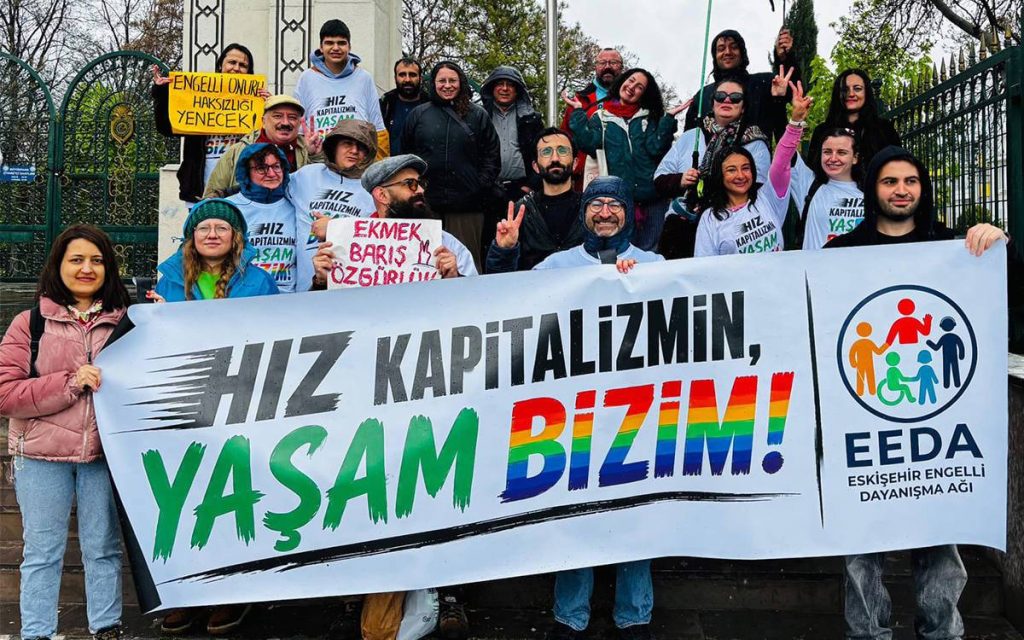
In the ableist regime, how we look at our bodies and how we perceive our limits are not independent of power relations. The struggle against ableism is an effort of internal rapprochement (rejoicing in one’s existence) against the whispers of “inadequacy” that cling to us and an effort to strengthen one’s power of existence (conatus) in the Spinozist sense. I think this theoretical ground is embodied in the experience of the Eskişehir Disability Solidarity Network (EEDA), which was established a while ago. In the sense that EEDA offers a powerful political space where people can exist without having to constantly defend themselves or justify their bodies. As I will convey shortly, in EEDA, subjects whom the system has already constructed as “objects of representation” have started to establish their own political voice by tearing apart the passive roles assigned to them; this conscious rupture will make them actors who are always “uncanny” and unsettling for the dominant paradigm. This situation proves that all groups that ableism tries to pull into line can meet on a common political line by setting aside their search for “exceptional identity,” and therefore, the actual constituent will that will make liberation possible lies exactly at the heart of these excluded margins. The first real field of struggle and practical application area of this new process of political subjectivation was May 1.
May 1: A practice of slowing down or the politics of slowing down

EEDA transformed its slogan “Speed belongs to capitalism, life belongs to us,” determined through common searches rising from different cities, into a bodily truth at the May 1 area. This conscious tempo displayed from the moment they joined the end of the march route turned slowing down from a theoretical discussion into a physical intervention that threw a wrench in the gears of the neoliberal time regime and the obsession with efficiency. This stubborn will, which the organizations and unions following behind had difficulty comprehending, was a powerful and political reminder of the possibility of resisting the system—which sees slowness as a “deficiency”—without becoming like the “enemy.” With this resilient stance, EEDA, the first cortege to enter the square representing all those left behind and kept on the “fringes of citizenship,” displayed a practice of constituent subjectivation that refused to be a window dressing at the May 1 square. We can detail the concrete manifestations of this anti-ableist persistence in the field and that clear rejection of representation relations as follows:
The collective subjectivity of those on the fringes: A line was established in the cortege where the presence was felt not only of people with disabilities but also of neurodivergent people, the chronically ill, the elderly, LGBTI+s, and everyone pushed out of society because they do not conform to body norms. While the demand for justice for the Afghan worker Vezir Mohammad Nourtani, who was killed by being burned, was raised, it also became visible how ableism, nationalism, labor exploitation, and exclusion regimes are articulated with one another.
Rejection of representation: Along with the anti-capitalist stance, the rejection of requests to take photos with local administrators or deputies meant the rejection of all kinds of oligarchic representation based on a relationship of granting. Because what EEDA believes is that things will change if another form of activism emerges—one that demands rights, establishes a political voice, and grows the struggle—against the silent, acceptable, and passive representation of people with disabilities.
Exposure and demand: In a way that showed how even a single person can make a meaningful difference, the anti-ableist text was read from the stage with the solidarity of Uğur Karslı from Eskişehir Eğitim Sen. Furthermore, in defiance of the historical silence created by being pushed to the fringes for years, the allotted time was consciously exceeded at the risk of making some unions uncomfortable. The exposure from the stage of the lack of ramps and sign language—which were not implemented despite prior agreement with the organizing committee—was not a technical detail, but a political reckoning and a will to object regarding who is accepted as a public subject.
Spatial intervention: The transformation of the stairs within the area into an alternative space of accessible resistance showed that freedom is not just something demanded, but a practice experienced starting today.
Will to sustain: EEDA announced from the stage that it would follow not only accessibility violations but also the rights violations faced by workers with disabilities in the city and the systematic exploitation in labor processes.
Conclusion: The possibility of a different kind of life
In conclusion, this movement is the common political line not only of people with disabilities but of all the “inconvenient” ones standing against speed, the imposition of performance, and neoliberal isolation—the mad, the migrants, the lepers, the disabled, the chronically ill, the elderly, LGBTI+s, and those who cannot receive an equal share of citizenship. We need each other’s solidarity and political presence more than ever to live. As La Boétie said, this collective will is the only way to stop gifting our eyes, feet, and fists to the powerful who crush us. Against those who draw the boundaries of the normal, this ground where those pushed to the fringes establish their own subjectivity contains a constituent power that will liberate us all by redefining speed, normality, and accessibility. Although this road is long and the order surrounding us is imposing, the idea of a “different kind of life” flourishes exactly in this slow and determined march.
*This text is a product not only of an individual effort but of the meticulous readings, final checks, and precious feedback of my comrades who are members of the Eskişehir Disability Solidarity Network (EEDA), strengthening the political line of the text. I thank all the friends who took the text out of being a personal narrative and made it part of a collective voice.
Source: BIANET