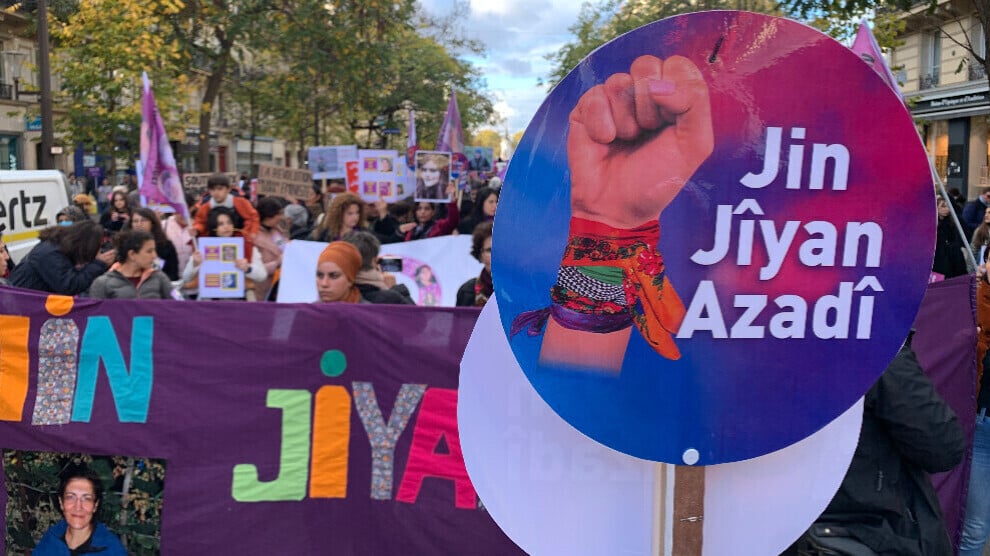
Three years after the violent death of Kurdish woman Jina Mahsa Amini at the hands of Iranian security forces, the Kurdish Women’s Movement in Europe (TJK-E) recalls the explosive social power of the slogan “Jin, Jiyan, Azadî” [Woman, Life, Freedom] and calls for international solidarity with the ongoing struggle in Iran.
In a statement released on the anniversary of Jina Mahsa Amini’s arrest, the TJK-E honored the victims of the uprising and emphasized the ongoing significance of the movement: “Democratic change and a free life require a women’s revolution.”
Amini, who was arrested by the morality police in Tehran on September 13, 2022, for allegedly violating Islamic dress codes and died three days later as a result of violence suffered in custody, has become a symbol of social change that extends far beyond Iran’s borders.
Global movement with Kurdish roots
The wave of protests following Jina Mahsa Amini’s death quickly developed into an international movement, carried by the Kurdish slogan “Jin Jiyan Azadî,” which focuses on the liberation of women. This expression goes back to Abdullah Öcalan’s understanding of women’s liberation and has spread worldwide as a “magic formula.” “The passion for a free life and the leading role of women in this social revolution have crossed oceans and mountains,” said the TJK-E statement.
Resistance against repression and the death penalty
Three years later, the movement remains unbroken, stated the TJK-E and noted that, despite massive repression, thousands of arrests, torture, and numerous executions, women, young people, and oppressed peoples in Iran have continued their protest. The statement highlighted three political prisoners sentenced to death: Varisheh Moradi, Pakhshan Azizi, and Sharifeh Mohammadi, who are considered symbolic figures of feminist resistance.
The TJK-E called for support for the campaign “No to Executions, Yes to Life,” which advocates for the abolition of the death penalty in Iran. It urged women’s rights and human rights organizations worldwide in particular to actively participate in defending the lives of political prisoners.
Criticism of authoritarian structures and global double standards
The statement criticized authoritarian and misogynistic developments worldwide and said: “The Rojava Revolution in North and East Syria offered a counter-vision to the patriarchal and militarized order in the Middle East. At the same time, the women’s revolution is being deliberately undermined through the transfer of power to the Taliban in Afghanistan or the political rehabilitation of “terrorists” – namely the self-proclaimed transitional president Ahmed al-Sharaa – in Syria. We are being forced to choose between two misogynistic and autocratic regimes. We women know no other option than a truly free and democratic life.”
Appeal to all oppressed peoples and international feminism
The TJK-E statement ended with an urgent appeal: “The people of Iran—from Kurds to Baluchis to Persians, Arabs, Azerbaijanis, and Lurs—should be supported in their struggle for freedom. In particular, the voices of women in Iranian prisons must be made heard loud and clear. Let us fight together until life is liberated. Once again: Jin, Jiyan, Azadî! The resistance is not over, it will not end. Let us raise the struggle together until life is liberated!”
Source: ANF News