
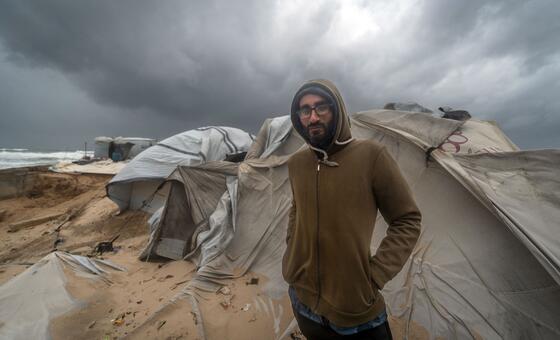
World News in Brief: Gaza braces for winter amid attacks, joint patrols in CAR, 90 cities commit to sustainable development
Over the past two days, partners recorded multiple airstrikes, as well as shelling, demolition blasts, naval fire and shooting across all of Gaza’s governorates, particularly west of the so-called “Yellow Line” established by Israeli authorities.
Humanitarians brought in additional fuel, plastic tarpaulins, winter clothing, medicines and medical supplies, but OCHA said these limited items were insufficient to meet people’s needs. Deliveries remain constrained by underfunding and Israeli restrictions, including bans on some partners’ operations, limits on imports such as engine oil and spare parts and restricted access to more than 64 per cent of Gaza’s land.
Meanwhile, the UN human rights office in the Occupied Palestinian Territory condemned an Israeli raid on Tuesday on premises in Al Bira, Ramallah, which Israeli forces claimed were the offices of two Palestinian civil society organizations, Addameer and the Union of Palestinian Women’s Committee.
Soldiers confiscated files and equipment and detained a journalist and a former prisoner, the office said, calling for an immediate end to the crackdown on Palestinian civic space.
Humanitarian partners called on Israeli authorities to stop the crackdown on Palestinian civic space, noting that such raids and the detention of human rights defenders and protection workers have had a “chilling effect”.
Central African Republic: UN peacekeepers and national army step up joint patrols in Vakaga
UN peacekeepers and national troops in the Central African Republic are stepping up joint patrols in the Vakaga prefecture in response to security concerns, the UN peacekeeping mission in the country, MINUSCA, said on Wednesday.
On Monday afternoon, peacekeepers from MINUSCA’s Zambian contingent and Central African Armed Forces (FACA) personnel patrolled the main roads in and around Birao. Patrols are also being reinforced in Am-Dafock and several surrounding localities.
The aim is to prevent threats against civilians, reassure communities and build trust between security forces and residents amid concerns and circulating rumours about the security situation.
“These joint operations reassure us. They alleviate our worries regarding the rumours and information currently circulating in our prefecture,” said Ahamat Adam, a community leader and member of the local peace committee, who hopes the patrols will be extended to other localities, including Tiringoulou and Sikikéde.
The patrols are also helping daily life and the local economy.
“When we see the FACA and MINUSCA patrolling together in town, we feel safer. It allows us to carry out our daily activities with greater confidence,” said Amina Alit, a trader at the Birao market.
Mayors from 50 countries commit to sustainable urban development
Ninety mayors from 50 countries met at the UN Forum of Mayors in Geneva earlier this week, renewing their commitments to make cities more sustainable and sending its recommendations to the UN Committee on Urban Development, Housing and Land Management, which opened its latest session on Wednesday.
Established in 2020, the Forum of Mayors connects city, national and global actors to share local solutions for implementing the UN Sustainable Development Goals.
Their commitments cover six areas:
- Efficient, safe, green and accessible transportation
- More green spaces, biodiversity protection, and lower pollution and emissions
- Inclusive, participatory planning and climate resilience
- Affordable, secure, climate-resilient housing for vulnerable people
- Protecting cultural and natural heritage for responsible tourism
- Using culture, creativity, innovation and ethical AI to improve urban services and civic participation
The mayors noted that across all areas, fiscal constraints, fragmented governance and limited local capacity hinder implementation and urged States and international organizations to strengthen the legal, institutional, policy and financial frameworks needed to address the issue.
The head of the UN Economic Commission for Europe (UNECE), which organises the forum, explained why cities must be at the heart of decision-making.
“Cities are where people experience the major challenges of our time most directly – from housing and access to essential services to mobility, climate impacts, inequality and disaster risks. But, cities are also where solutions are being developed every day,” she said.
Source: UN News